For two reasons. One is, it makes you actually very vulnerable if you’re a heavily debt-encumbered homeowner. And actually, the initial legislation was kind of interesting, the debate around it back in the 1930s, when it kind of said debt-encumbered homeowners don’t go on strike, and because it’s—you know, you’ve got to pay your mortgage. And so, this becomes, as it were, a millstone around your neck. And that then makes you very vulnerable to fluctuations in the market like we’re seeing right now, particularly if you have variable rate mortgages, things of that kind, and you can really easily get caught out. So, in effect, what we’ve seen in the housing market is a tremendous plundering of the assets of some of the most vulnerable people in the country. I mean, this has been the biggest loss of asset wealth to the African American population that there’s ever been.
(...) But as soon as the big guns get into trouble, the state bails them out. And this is what we call moral hazard, that actually because you’re bailing out Wall Street all of the time, then Wall Street will take high risks. And they’ve taken immensely high risks over the last thirty years and again and again and again being caught out. And each time they get caught out, the state steps in and saves them. That’s the connection, if you like, between the state and Wall Street. That’s the connection that has to be broken.
(...) I don’t see the neoliberalism as dead, if you say that neoliberalism is about consolidation of class power, because actually we’re seeing the further consolidation of it right now, rather than the lessening of it. And that’s what I—when I talk about the bank bailout, that’s what it was doing. So I’m kind of concerned.

Showing posts with label sub-prime mortgages. Show all posts
Showing posts with label sub-prime mortgages. Show all posts
Thursday, April 2, 2009

Thursday, October 30, 2008
Not just mortgage lenders and subprime borrowers were caught up in the frenzy. A growing crowd of real estate speculators got into the business of buying houses in order to sell them off at higher prices. Many homeowners also began to view the rapid increase in the value of their homes as natural and permanent, and took advantage of low interest rates to refinance and withdraw cash value from their homes. This was a way to maintain or increase consumption levels despite stagnant wages for most workers. At the height of the bubble new mortgage borrowing increased by $1.11 trillion between October and December 2005 alone, bringing outstanding mortgage debt as a whole to $8.66 trillion, equal to 69.4 percent of U.S. GDP.
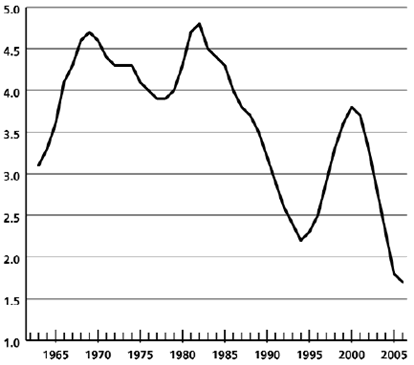
(...) It was netinvestment in the private sector that was once the major driver of the capitalist economy, absorbing a growing economic surplus. It was relatively high net private non-residential fixed investment (together with military-oriented government spending) that helped to create and sustain the “Golden Age” of the 1960s. The faltering of such investment (as a percent of GDP) in the early 1970s (with brief exceptions in the late 1970s–early 1980s, and late 1990s), signaled that the economy was unable to absorb all of the investment-seeking surplus that it was generating, and thus marked the onset of deepening stagnation in the real economy of goods and services. The whole problem has gotten worse over time. Nine out of the ten years with the lowest net non-residential fixed investment as a percent of GDP over the last half century (up through 2006) were in the 1990s and 2000s. Between 1986 and 2006, in only one year—2000, just before the stock market crash—did the percent of GDP represented by net private non-residential fixed investment reach the average for 1960–79 (4.2 percent). This failure to invest is clearly not due to a lack of investment-seeking surplus. One indicator of this is that corporations are now sitting on a mountain of cash—in excess of $600 billion in corporate savings that have built up at the same time that investment has been declining due to a lack of profitable outlets. What has mainly kept things from getting worse in the last few decades as a result of the decline of net investment and limits on civilian government spending has been soaring finance. This has provided a considerable outlet for economic surplus in what is called FIRE (finance, insurance, and real estate), employing many new people in this non-productive sector of the economy, while also indirectly stimulating demand through the impact of asset appreciation (the wealth effect).

(...) It was netinvestment in the private sector that was once the major driver of the capitalist economy, absorbing a growing economic surplus. It was relatively high net private non-residential fixed investment (together with military-oriented government spending) that helped to create and sustain the “Golden Age” of the 1960s. The faltering of such investment (as a percent of GDP) in the early 1970s (with brief exceptions in the late 1970s–early 1980s, and late 1990s), signaled that the economy was unable to absorb all of the investment-seeking surplus that it was generating, and thus marked the onset of deepening stagnation in the real economy of goods and services. The whole problem has gotten worse over time. Nine out of the ten years with the lowest net non-residential fixed investment as a percent of GDP over the last half century (up through 2006) were in the 1990s and 2000s. Between 1986 and 2006, in only one year—2000, just before the stock market crash—did the percent of GDP represented by net private non-residential fixed investment reach the average for 1960–79 (4.2 percent). This failure to invest is clearly not due to a lack of investment-seeking surplus. One indicator of this is that corporations are now sitting on a mountain of cash—in excess of $600 billion in corporate savings that have built up at the same time that investment has been declining due to a lack of profitable outlets. What has mainly kept things from getting worse in the last few decades as a result of the decline of net investment and limits on civilian government spending has been soaring finance. This has provided a considerable outlet for economic surplus in what is called FIRE (finance, insurance, and real estate), employing many new people in this non-productive sector of the economy, while also indirectly stimulating demand through the impact of asset appreciation (the wealth effect).
Subscribe to:
Posts (Atom)