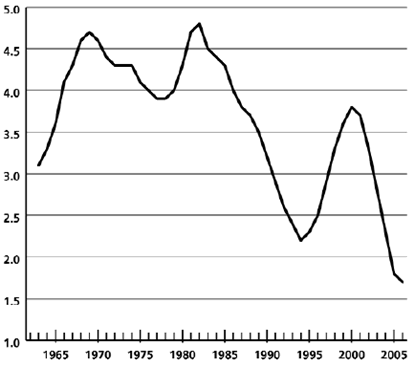
(...) Hence, what Keynes called the “outstanding faults” of the capitalist economy are hardly addressed as such. Keynes, is presented, by his most publicised (and reactionary) biographer, as the great “remedist” and little else.13 The resulting policy emphasis is on fiscal stimulus, a mild redistribution of income, renewed financial regulations, and international reforms in currency trading. The crisis is treated as a kind of external shock (or, as Krugman says, the spread of an unknown virus).14 The severity of the downturn would suggest that long-term forces (more than the normal business cycle factors) are concerned. Yet, the fact that capitalism is an inherently contradictory historical system, which displays increasing irrationality in its later stages is off limits within the economics mainstream, even among its supposedly left of centre theorists, such as Krugman and Joseph Stiglitz.
(...) Part of the problem is that although Keynes’s thinking was too radical for the system he was trying to defend, it was at the same time not radical enough. It did not fully explain the core contradictions of capitalism. For a truly general theory of accumulation and crisis under capitalism Marx together with later Marxian political economy remain critical. For Marx the essence of capitalism lay, according to his famous shorthand, in the relation M-C-M’. Capitalism was a system in which money capital (M) was exchanged for commodities (C) that were transformed into new commodities through production, which were then sold again for more money M’ (or M + ∆m, i.e., surplus value). The nature of this process was such that it was unending. The M’ was then reinvested in the next period of production, with the object of getting M’’ at the end, and so on, ad infinitum.15 Any interruption in the unending accumulation of capital in this sense pointed to a crisis. Moreover, the very existence of a system organised in this way made it possible for a crisis to occur through a shortage of effective demand. For Marx, there was never any doubt about the root cause of capitalist economic crises. “The ultimate reason for all real crises always remains the poverty and restricted consumption of the masses as opposed to the drive of capitalist production to develop the productive forces as though only the absolute consuming power of society constituted their limit”.16
(...)With respect to financial expansion and crisis, Marx wrote in volume 3 of Capital that the whole “sphere of production may be saturated with capital”, with the result that profits increasingly enter into the sphere of speculation. “If...new accumulation”, he wrote,
meets with difficulties in its employment, through a lack of spheres for investment,
i.e., due to a surplus in the branches of production and an over-supply of loan capital, this plethora of loanable money-capital merely shows the limitations of capitalist production. The subsequent credit swindle proves that no real obstacle stands in the way of the employment of this surplus-capital. However, an obstacle is indeed immanent in its laws of expansion, i.e., in the limits in which capital can realise itself as capital.17
The “credit swindle”, arising with the turn to money capital (represented by Marx as M to M’) as the basis of the amassing of wealth, inevitably precedes a bust. “Business always appears excessively sound right on the eve of a crash”. For Marx nothing was more natural than a liquidity crisis in an economic slowdown, where capital hungered insatiably for cash. Mimicking the 42nd Psalm, he wrote that the capitalist desires and hordes money in every form: “As the hart pants after fresh water, so pants his soul after money, the only wealth”.18
(...) Yet, if Marx constitutes the starting point for a general theory of capitalism and crises, his analysis doesn’t encompass many of the specific problems of today, given the historical evolution of the system since his time. For Marxists, beginning with Hilferding, Lenin and Luxemburg, the historical evolution of the system in the early twentieth century was understood primarily in terms of the development of a new stage of capitalism, often referred to as monopoly capitalism. This reflected the fact that the most significant change in the structure of capitalism in the twentieth century arose out of what Marx called the concentration and centralisation of production, resulting in the rise of the giant firm and the modern credit system.
(...) Their work was extended into an analysis of the role of the state and popularised in Paul Baran and Paul Sweezy’s Monopoly Capital: An Essay on the American Economic Order (1966).20 This theoretical perspective was later applied to the world economy and the creeping stagnation of the 1970s, ’80s and ’90s, in a series of works by Sweezy and Magdoff. These thinkers argued that the capitalist economy did not naturally tend toward rapid growth.21 Rather specific historical “developmental factors” were necessary for strong growth to appear for any length of time.22 This was particularly the case for a system dominated by monopoly capital, in which monopolistic price formation and profits were associated with certain restraints on accumulation. The main problem of accumulation for monopolistic corporations was to find sufficient investment outlets for the enormous and rising surplus at their disposal. Short of new historical factors that increased investment outlets, absorbing surplus capital, the accumulation system tended to sputter out. Hence, “the normal state of the monopoly capitalist economy”, Baran and Sweezy argued, was “stagnation”.23
(...) In the decades immediately after the Second World War the United States and the other advanced capitalist economies experienced a period of prosperity, subsequently described as the “Golden Age”. This was based on the stimulus from special historical factors such as (1) a high level of consumer liquidity immediately after the war; (2) the rebuilding of the war-devastated European and Japanese economies; (3) a second great wave of automobilisation (which included the impetus to the rubber, steel, and glass industries, the building of the interstate highway system, and the suburbanisation of the country); (4) the growth of the sales effort in the form of the expansion of advertising and other forms of sales-related waste; and (5) high military spending associated with two regional wars in Asia. But by the 1970s these countervailing factors to the tendency to stagnation were mostly on the wane. The result was a rapid slowing down of the economy. Net investment in the United States declined, with the investment that was taking place being fed largely out of corporate depreciation funds. In this situation, a new outlet for the surplus (profits) of corporations was needed.
(...) Magdoff and Sweezy argued, as early as 1970, that there was a “long-run decline in liquidity” arising from the putative “‘success’ in controlling the business cycle”. The result was that the US economy was faced with the growing problem of a major “debt-squeeze out”, requiring that real and paper values be brought back into accord, sometime in the future. The longer that debt ballooned without a major contraction the bigger the problem would become.25 Incredibly, this process of financial expansion continued over the decades, with only relatively minor credit adjustments or “credit crunches”, until the Great Financial Crisis of 2007–09.
(...) Total debt in relation to GDP in the US economy rose from 151 percent in 1959 to 373 percent in 2007, with the quality of debt decreasing as its quantity expanded. But the real economy showed an increasing addictive toleration—the need for more to get even a decreasing effect—to the expansion of debt. In the 1970s the increase in US GDP was about sixty cents for ever dollar of new debt, by the early 2000s this had decreased to around twenty cents for every dollar of new debt.27
(...) In 1997, Paul Sweezy declared that globalisation was a very long-term trend of capitalism, traceable to its very origins in the fifteenth and sixteenth centuries. This globalising trend had major effects in some periods such as the rise of China as a major force in the world economy. Nevertheless, the dominant phenomena governing world accumulation at the end of the twentieth century, he argued, were the trio of “(1) the slowing down of the overall rate of growth, (2) the worldwide proliferation of monopolistic (or oligopolistic) multinational corporations, and (3) what may be called the financialisation of the capital accumulation process”.29 It was clearly financialisation that was the most startling and unstable development. If the financialisation process were to go into reverse or even to slow, Sweezy suggested, the result would be a deep stagnation. There was no telling when this would happen. Financialisation, Magdoff and Sweezy argued, could continue for some time. Still, at some point the rising mountain of debt would grow beyond the capacity of capitalist governments to intervene effectively as the lender of last resort, and a financial avalanche would result in an unprecedented crisis. Such a major, historic crisis of capitalism, arising out of conditions that were equally unprecedented, would pose not merely the “return of depression economics” as this was understood, in a very limited fashion, by orthodox economists, but would mean the collapse of an entire financialised regime of accumulation with lasting real world repercussions. The most likely long-term result was a deep slowdown in the trend-rate of growth. With the Great Financial Crisis of 2007–09 and the advent of the most serious economic downturn since the Great Depression these expectations based on an understanding of the historical development of the system have come true. In terms of the conditions that are to be experienced by working populations around the globe as a result of this unprecedented downturn (comparable only to the 1930s) the worst is clearly still to come.
(...) Already, emerging economies, where the crisis may turn out to be most wrenching, are finding their export markets drying up. For China, with exports in 2001–06 amounting to over 30 percent of GDP, and net exports close to 4 percent of GDP, the shrinking of markets in the United States, Europe, and Japan constitutes a serious threat. China currently is experiencing the sharpest deceleration in economic growth in thirty years. Chinese exports have dropped, auto sales have plummeted, and jobs are shrinking in the cities. House prices are now falling in major urban areas and there is a drastic decline in real estate investment, which spells a much bigger financial crisis. Millions of China’s “floating population” of migrant workers who fueled industrialisation are unemployed and are returning to rural areas. The sharp drop in economic growth and looming signs of deflation in China, it is feared, will pull world economic growth down to close to zero.30 To the not inconsiderable extent that the US generated global financial explosion has contributed to the growth in the Chinese real economy the US generated global financial implosion shall contribute to its contraction. Economic crises are endemic to capitalism, but the level of economic disaster affecting the system, as shown by conditions in the United States, on the one hand, and China, on the other, is now without precedent in the post-Second World War period, and the end is not yet in sight.
(...) The most serious ecological threat is of course global warming, which is inducing widespread, multi-faceted climate change, with disastrous implications for life on earth. But in a wider sense, the global environmental crisis involves manifold problems and cannot be reduced to global warming alone. These multiple hazards have a common source in the world economy, including: the extinction of species, loss of tropical forests (as well as forest ecosystems generally), contamination of and destruction of ocean ecology, loss of coral reefs, overfishing, disappearing supplies of fresh water resources, the despoliation of lakes and rivers, desertification, toxic wastes, pollution, acid rain, the approaching exhaustion of easily available crude oil resources, urban congestion, the detrimental effects of large dams, world hunger, overpopulation, etc. Together these threats constitute the greatest challenge to the survival of humanity since its prehistory.
(...) James Hansen, director of NASA’s Goddard Institute of Space Studies, and other climatologists, now claim that the goal must be to reduce the atmospheric carbon level below the present 387 ppm, to 350 ppm or less. This means that net CO2 emissions must “approach zero”. It also necessitates major changes in energy and land use, requiring massive social reorganisation. According to Hansen and his colleagues, “if the present overshoot of this [350 ppm] target CO2 is not brief, there is the possibility of seeding irreversible catastrophic effects”. Indeed, “continued growth of greenhouse gas emissions, for just another decade, practically eliminates the possibility of near-term return of atmospheric composition beneath the tipping level for catastrophic effects”. The world is now facing the prospect of irrevocably leaving the mild, protective climate of the Holocene, which has defined the environmental conditions for the entire duration of human civilisation.
(...) Indeed, there is only one way of accounting for the fact that orthodox economists constitute the leading ideological opponents of aggressive reductions in greenhouse gas emissions, even at the risk of a planetary inferno—and that is their primary role as ideological defenders of the capitalist system and promoters of its drive for profits and accumulation at any cost. Nothing so clearly demonstrates what John Kenneth Galbraith characterised (in the title to his last book) as The Economics of Innocent Fraud. “Capitalism, as we know it today”, James Gustave Speth, former head of the United Nations Development Programme, has written, “is incapable of sustaining the environment”.36 To turn to mainstream economics for answers is therefore a serious, perhaps fatal, error of current policy.
(...) From an ecological perspective, of course, this system of growth at any cost, synonymous with capitalism, places the world economy in direct conflict with environmental sustainability. China’s rapid growth in recent decades has also led to record rates of environmental degradation on its part. China is now close to the United States in annual carbon dioxide emissions, though far below the latter in emissions per capita. Yet, despite the seriousness of this contradiction between the capitalist economy and the planet, establishment economists generally argue against any major attempt to avert climate change, i.e., to bailout nature. At the same time they do not hesitate to advocate spending trillions of dollars to bailout banks. President-elect Obama’s chief economic advisor, Larry Summers, is notorious for his anti-environmental diatribes. He has said, on more than one occasion, that it makes as much economic sense in terms of future welfare to spend on various non-environmental factors—for example, to rebuild infrastructure (roads, bridges, etc.)—as to seek to preserve the environment, say, tropical forests. In addressing the global warming problem, Summers naively stated in 1992, that under “the most pessimistic estimates yet prepared...global warming reduces growth over the next two centuries by less than 0.1 percent a year”.39 Yet, under the most pessimistic estimates of climatologists at that time—now proving accurate—global warming under business as usual threatened both life on the planet and human civilisation itself. Indeed, nothing is more deranged than the notion of Summers and other orthodox economists that the planet as we know it can be destroyed, while the capitalist economy can continue as before.
(...) The growing scale of the capitalist economy and the weight that it is imposing on a limited biosphere are not everything. More important, ultimately, is the actual integrity of ecosystems and the basic biogeochemical processes of the earth system. Here Marx’s theory of the metabolic rift helps us understand capitalism’s intensive, not merely extensive, destruction of the environment. Marx’s vision had included an ecological element from the beginning. In his Economic and Philosophic Manuscripts of 1844 he wrote of the environmental damage wrought by industrial capitalism, in the form of the “universal pollution to be found in large towns”. For Marx, “Man lives from nature, i.e. nature is his body, and he must maintain a continuing dialogue with it if he is not to die”.40 But Marx’s ecological critique of capitalism crystallised only with the publication of Capital, volume 1 in 1867. He was influenced by the critique of British industrial agriculture developed by Justus von Liebig, the leading German chemist of the day. Building on Liebig, Marx pointed to the fact that by shipping food and fiber hundreds and even thousands of miles to new urban centres (a reflection of the growing division between town and country) industrialised capitalist agriculture was in fact depleting the soil of basic nutrients (such as nitrogen, potassium, and phosphorus), which were no longer recirculated to the earth. This created a major crisis of the soil in Europe and the United States in the nineteenth century. Marx described this as an “irreparable rift in the interdependent process of social metabolism, a metabolism prescribed by the natural laws of life itself”. He argued that society demanded the “restoration” of a sustainable human metabolism with nature, which however could only be accomplished under a society of associated producers.41 In the most radical conception of sustainability ever developed, Marx wrote:
From the standpoint of a higher socio-economic formation, the private property of individuals in the earth will appear just as absurd as the private property of one man in other men. Even an entire society, a nation, or all simultaneously existing societies taken together, are not owners of the earth. They are simply its possessors, its beneficiaries, and have to bequeath it in an improved state to succeeding generations, as boni patres familias [good heads of the household].42
(...) Confronted with ecological crises, no attempt is made by the system to go to the root of the problem in the social relations that are undermining what Marx called “the vital conditions of existence”. Rather the problem is shifted around, with capitalism continuing “to play out the same failed strategy again and again”.45 The result is a compounding of ecological disaster. The solution that capitalism provided to the nineteenth century soil crisis that Liebig and Marx addressed was not to restore the human metabolism with the soil, but rather to develop synthetic, particularly nitrogen-based, fertilizers, which marked the beginning of modern agribusiness, and which (because of the high petroleum use) is a major source of global warming, as well as contributing to ocean dead zones. Capitalism’s solution to world agricultural production in the form of modern agribusiness has resulted in a further polarisation of wealth and hunger. Of the more than six billion people in the world today, the United Nation indicates that around one billion are hungry, and their numbers (both relative and absolute) are growing. In the United States itself over 36 million people, about 12 percent of the population, were “food insecure” in 2007.46
(...) Yet, globalisation taken in itself is not a very useful way of understanding the accumulation dynamic of the system at this specific stage of its development, which is better characterised, as Sweezy argued, in terms of the three elements of slow growth (in the centre and in the world economy as a whole), monopolisation via multinational corporations, and financialisation. Continuing globalisation, coupled with financialisation, has created the illusion, propagated by some ideologues of the system, that “the world is flat”.47 Yet, capitalism remains a world economic system divided into separate nation states with differing power resources—a contradiction that is impossible to transcend within the system. Meanwhile, the growth of multinational corporations based in the centre countries has served historically to channel global surpluses away from the peripheries toward the centres. The concentration of power (economic, military, financial, communications) at the centre is intrinsic to capitalism as a world system, although the specific nations that constitute the centre and periphery (and semi-periphery) may change. The world economy is therefore disproportionately focused on the needs of accumulation at the core. The capitalist world system is most stable when governed by a single hegemonic power, such as Britain for most of the nineteenth century, and the United States for most of the twentieth. In periods of hegemonic instability and world economic crisis the system approaches conditions of total crisis, as witnessed by the First and Second World Wars.
(...) At present there are very palpable fears in Washington’s higher circles regarding the continuing—and from their perspective necessary and non-negotiable—role of the dollar as trade settlement and reserve currency, even in the face of current Chinese support for the dollar system. Washington understands that China’s blind support for the dollar is problematic, especially in the event of a rapid devaluation of all existing dollar obligations resulting from Federal Reserve policy. China holds $652 billion in US Treasury debt (an increase from $459 billion at the end of 2007). Altogether it owns 10 percent of the US public debt. A rapid devaluation of the dollar would only be seen in China as an expropriation. An ensuing movement of China away from the dollar, however limited—and none but limited moves are immediately possible—could drastically destabilize the entire US dominated world economic order.52
(...) The fault lines are most obvious in terms of the peril to the planet. As Evo Morales, president of Bolivia, has recently stated: “Under capitalism we are not human beings but consumers. Under capitalism mother earth does not exist, instead there are raw materials”. In reality, “the earth is much more important than [the] stock exchanges of Wall Street and the world. [Yet,] while the United States and the European Union allocate 4,100 billion dollars to save the bankers from a financial crisis that they themselves have caused, programs on climate change get 313 times less, that is to say, only 13 billion dollars”.55
(...) What exactly this something else is we do not know, and cannot know at this point: because it depends on the responses not just of states and corporations, but more importantly the response of the world’s populations. On top of the intense class alienation, exploitation, and inequality endemic to capitalism at every level, we are now faced with widening global fractures. So far, on a continental level, leadership in recognising that the only answer is the revolutionary one—a new socialism for the twenty-first century—has been taken by the peoples of Latin America, in Cuba, Venezuela, Bolivia, Ecuador, and is also manifest in struggles taking place in Brazil, Mexico, Nicaragua, and elsewhere.58 Latin America, which was the first continent to feel the full brunt of neoliberal globalisation, the hardest hit region outside of the Middle East in terms military interventions in the last quarter-century, and the region that was the initial basis of US international hegemony, is now showing the way to the world—not only in relation to the struggle for substantive equality, which is essential, but also in relation to saving the planet from capitalism. As Morales has stated, “Humankind is capable of saving the earth if we recover the principles of solidarity, complementarity, and harmony with nature, in contraposition to the reign of competition, profits, and rampant consumption of natural resources” that distinguishes the failed system of capitalism.59