
Showing posts with label debt. Show all posts
Showing posts with label debt. Show all posts
Wednesday, July 28, 2010
High expenditures in the past two fiscal years have attributed to the rise in public debt, which has reached a critical level of Rs9.0 trillion by end of FY-2010 compared to end-June 2009 amount of Rs7.795 trillion. Public debt has surpassed the tax-to-GDP limit of 60.0 per cent set by the Fiscal Responsibility and Debt Limitation Act (FR&DLA), to 61.0 by the end of FY-2010. There is an urgent need for a viable debt management strategy that would reduce the over reliance on external inflows and domestic borrowings, decrease cost of debt-servicing and create substantial space for growth and development. The strategy has to be comprehensive enough to address all the issues that contribute towards accumulation of national debt.

Friday, October 30, 2009
Over 92 percent of the US aid money granted in previous years is being spent through the American NGOs resulting in the return of a fair portion of the financial assistance back to the donor country. The News investigation found that of the projects run through $1.05 billion assistance, the government agencies were granted an amount of $29.68 million (2.78% of the total amount), UN bodies received $50.80 million (4.8%) and US NGOs bagged projects of $960 million (92.30%). This coincides with Ambassador Holbrook’s disclosure about short-listing more than 1,000 NGOs for awarding contracts in Pakistan.
Sunday, February 8, 2009
The interim government, built from a coalition of the Left-Green Party and the Social Democrats, is at least as different from the old one as the Obama administration is from the Bush administration. The latest prime minister, Jóhanna Sigurdardóttir, broke new ground in the midst of the crisis: she is now the world's first out lesbian head of state. In power only until elections on April 25th, this caretaker government takes on the formidable task of stabilizing and steering a country that has the dubious honor of being the first to drop in the current global meltdown. Last week, Sigurdardóttir said that the new government would try to change the constitution to "enshrine national ownership of the country's natural resources" and to "open a new chapter in public participation in shaping the structure of government," a 180-degree turn from the neoliberal policies of Iceland's fallen masters.
Thursday, December 4, 2008
There has already been an enormous destruction of capital. In the last number of months, more than $7 trillion has been wiped off the U.S. stock market. Indeed, $1.1 trillion was wiped out in a single day on October 15. As of mid-October, $27 trillion had been erased from stock markets worldwide. Housing values in this country have already declined by $5 trillion; pension funds by $2.5 trillion; and bank write-offs are now at $600 to $700 billion and expected to be $1.4 trillion. Large, conservative, seemingly stable companies have disappeared. Lehman Brothers, which had been capitalized at $30 to $40 billion, has gone bankrupt, and AIG, which until a few months ago was capitalized at between $150 and $200 billion, required a $123 billion lifeline from the government to survive. This has led to a massive credit crunch. Banks and other financial institutions now no longer trust each other not to totter and collapse underneath the weight of toxic debt, and refuse to lend to each other, producing a credit meltdown affecting the entire global financial system.
(...) The banks are also being de-leveraged, that is, they are being forced to pay off some of their debt and to cut back on the risky loans they’ve made over the past several years. Rather than loaning ten times more than their capital, they were loaning thirty and forty times their capital; and in Europe the banks were leveraged at an even greater rate.
(...) The current crisis is a product of the contradictions of the twenty-five-year-long neoliberal boom, which started in 1982. The postwar boom ended in 1973, and from 1973 to 1982 there were three recessions in the United States. The restructuring that went on in the United States, and to a lesser extent internationally, with the introduction of neoliberal, free-market measures, led to a twenty-five-year-long boom. It is the contradictions of those neoliberal measures that have produced this crisis.
(...) The first contradiction to note was the creation of a giant debt bubble. The increase in debt during the Clinton and Bush years was staggering. Over the two decades preceding 2007, credit market debt roughly quadrupled from nearly $11 trillion to $48 trillion, far exceeding growth rates. To put it in perspective: according to the Wall Street Journal, since 1983 debt expanded by 8.9 percent per year, while GDP expanded by only 5.9 percent.
(...) The second contradiction was that the United States became a buyer of last resort, establishing a trading system with Asia in which the Asian countries exported to the United States, which kept up spending through debt. The American balance of payments went from approximately $200 billion a year to $700 to $800 billion per year. All of this was borrowed. The U.S. government had a budget surplus under Clinton. But under Bush, with the tax cuts and war spending, the budgetary surplus disappeared, and the U.S. went from having a $250 billion government surplus in 2000–2001 to a $300 billion deficit in 2002. This stimulated the economy, but it meant that the United States became dependent on foreign capital, since the savings rate in this country had collapsed and was negative in the last years of this boom. Foreign capital, in particular from China, Japan, and the Middle East oil exporting countries, financed the American debt. When the dot-com bubble collapsed and recession came in 2001, Federal Reserve Chairman Alan Greenspan lowered interest rates to between 1 and 2 percent for three years. This led to massive asset inflation, particularly in housing prices.
(...) The neoliberal boom was the result of a shift in the balance of class forces, in which the rate of exploitation was increased, real wages were depressed, and almost all wealth created went to capital. Some figures will indicate how dramatic the shift was. In 1973, GDP per person, in constant non-inflationary dollars, was $20,000 a year. By 2006, it was $38,000 a year—a more than 90 percent rise. Wages, however, in that same thirty-three-year period, declined. Real wages in 1973 were $330 per week; and in 2007, wages were $279—a decline of 15 percent.
(...) This shift of wealth from the working class to the capitalist class produced a tremendous amount of capital for potential investment. But in this last business cycle, that capital could not find all that many profitable outlets domestically. There was no expanded reproduction, no accumulation of capital in the U.S. during the 2000s. In this last business cycle, there were fewer factories at the beginning of the recession a year ago than there were in 1999. Instead of investing in new technologies, new plants and equipment, capitalists invested money overseas. Domestically, investments went to the most profitable industries—housing, construction, and finance. “In 1983, banks, brokerage houses and other financial businesses contributed 15.8 percent to domestic corporate profits,” writes James Grant in the October 18 Wall Street Journal. “It’s double that today.”
(...) These investments stimulated the housing and debt bubble. Between 2000 and 2005, housing prices increased by more than 50 percent, and there was a frenzy of housing construction. Banks and other financial institutions went on a mortgage-lending spree, creating a massive market in subprime mortgages—adjustable rate mortgages sold to borrowers with weak credit. There was also a big increase in housing speculation, with small investors buying second and third homes with the expectation that housing prices would keep rising and that these houses could be resold at a profit. Merrill Lynch estimated that in the first half of 2005, half of economic growth was related to the boom in the housing sector.
(...) Meanwhile, workers tried to maintain their standard of living despite the decline in real wages. In the 1980s and 1990s, they worked longer hours, took on more than one job, and increased the number of family members working. This could prop up household income to some extent. Yet even household income declined from 1998 through the boom of the 2000s. The only way to maintain living standards in the midst of declining wages was by borrowing against the rising value of their homes through home equity loans and mortgage refinancing. In the period of the last boom, homeowners took $5 trillion out of their home equity ($9 trillion since 1997), fueling an increasingly unsustainable debt structure that finally popped with the decline of inflated asset prices in housing.
(...) In this shadow system, banks did not have to put up adequate capital reserves. As a result, they were able, through this unregulated system, to borrow thirty, forty, or fifty times above the value of their capital in order to invest in the stock market and in various new exotic debt products, such as collateralized debt obligations (CDOs), credit-default swaps (CDSs—essentially a form of insurance against debt default), and various other financial swindles, many of which were based on the packaging and repackaging of housing mortgages. These were bundled and sliced up into investment vehicles that contained a good deal of potentially toxic debt—$900 billion worth of subprime loans, for example.
(...) Now that the world has entered recession, the U.S. is going to be running higher budgetary deficits. Those deficits will be increased also by the expansion of U.S. military spending, which has increased from $300 billion a year in 2000 to more than $800 billion a year now, if you include the supplemental costs for the wars in Iraq and Afghanistan. On top of this spending, the U.S. has introduced a hugely expensive bailout plan. That means it will in all likelihood be running deficits of three-quarters of a trillion dollars, and possibly more, in the coming years. Where will the money for that come? At the moment there is no savings in this country, though that may change dramatically. But it is highly unlikely that China, Japan, and other countries are prepared to continue to finance an American trade deficit to the tune of $700 or $800 billion a year when the balance sheet of American finances, the huge national debt, has gone from $5 trillion when Bush came into office to $11 trillion today. It is unlikely that the Chinese and others are going to continue to finance this debt—although at this point in time U.S. treasuries are still a safe haven. This is particularly true because China’s trade surplus is going to contract considerably as a result of the world recession.
(...) The Chinese population only consumes 35 percent of what it produces. The rest goes for reinvestment and export. China’s economy has the highest rate of exploitation in the industrial world. But its export markets are going to constrict—they’ve already started to decline. As a result, China’s desire to lend greater amounts to the United States is problematic, particularly if interest rates in the United States are low. The United States therefore can no longer continue to run an enormous trade deficit while it is building an enormous budgetary deficit, and sustain both of them on the basis of foreign borrowing. There will have to be a restructuring and reordering of the system. At the same time, the U.S. may become more dependent on direct foreign investment from countries like Japan and China that, as we’ve mentioned, have developed large cash reserves. That is what we mean when we say that this is not just a typical cyclical crisis of capitalism. All of the contradictions of the neoliberal boom have burst asunder and now have to be addressed.
(...) In their ad-hoc attempts to solve the crisis, officials took this to be a liquidity rather than an insolvency problem—a problem simply of getting money into the banking system so that the banks would loan. But the banks refused to loan to each other because they knew that other banks had assets on their books that were as bad as their own—and which might lead to defaults. This is called counterparty risk: banks are afraid that the other banks are on the verge of bankruptcy and so won’t give them loans. This aversion to risk reached a crescendo when Lehman Brothers was allowed to go bankrupt in mid-September. This is what led to the credit meltdown of late September into mid-October that roiled markets all over the world.
(...) Estimates are that the U.S. has so far committed $4 to $6 trillion in tax dollars to bailout efforts, and Europe has committed $2.3 trillion. But this isn’t so much cooperation as it is an attempt by each state to keep pace with its national rivals. Everyone understands to some extent what happened in the 1930s—that the recession became a world depression when the international banking system collapsed and states imposed beggar-thy-neighbor policies that further contracted world trade and deepened the world depression. Yet at the same time there are limits to what states can do because they also compete with each other. Each one only controls a small patch of an integrated world economy. State intervention can therefore mitigate the effects of the crisis, but it cannot prevent the recession.
(...) The U.S. in the late 1980s and 1990s improved its competitive position in the world economy and attempted to assert its role as the sole superpower. Though it secured better rates of growth than its competitors in Japan and Europe over the past twenty-five years, it fell behind the growth rates of emerging nations like China, and in order to sustain its own economy it fell into debt. The result is that in the last decade, the United States has lost its competitive position on the world market. Now it will have to restructure, which will involve attempting to raise the rate of exploitation—increasing productivity while lowering wages and benefits even further. We’ve already seen it in the auto industry, where wages have already been cut in half in many cases. The United States will become a cheap labor country compared to its competitors. Auto wages in this country are probably about a third of what they are in Germany. The minimum wage is half of what it is in Britain, France, Germany, and Ireland. The contradictions of neoliberalism have increased the immiseration and the poverty of the American working class. And to get out of the crisis they are going to attack workers’ living standards even further.
(...) On the other hand, there’s an enormous opening for a Left that has been marginalized for decades. The disaster of the free market makes it easier for us to argue about the failure of capitalism and the need for an alternative based on human needs. The free market, which supposedly triumphed in 1989 and brought us the “end of history,” has led to nothing but misery and the ruin of millions of people, who are mired in poverty, hunger, unemployment, and ill health, but thanks to the free-market mania of the past decades, face a shredded safety net that doesn’t begin to address these problems.
(...) The banks are also being de-leveraged, that is, they are being forced to pay off some of their debt and to cut back on the risky loans they’ve made over the past several years. Rather than loaning ten times more than their capital, they were loaning thirty and forty times their capital; and in Europe the banks were leveraged at an even greater rate.
(...) The current crisis is a product of the contradictions of the twenty-five-year-long neoliberal boom, which started in 1982. The postwar boom ended in 1973, and from 1973 to 1982 there were three recessions in the United States. The restructuring that went on in the United States, and to a lesser extent internationally, with the introduction of neoliberal, free-market measures, led to a twenty-five-year-long boom. It is the contradictions of those neoliberal measures that have produced this crisis.
(...) The first contradiction to note was the creation of a giant debt bubble. The increase in debt during the Clinton and Bush years was staggering. Over the two decades preceding 2007, credit market debt roughly quadrupled from nearly $11 trillion to $48 trillion, far exceeding growth rates. To put it in perspective: according to the Wall Street Journal, since 1983 debt expanded by 8.9 percent per year, while GDP expanded by only 5.9 percent.
(...) The second contradiction was that the United States became a buyer of last resort, establishing a trading system with Asia in which the Asian countries exported to the United States, which kept up spending through debt. The American balance of payments went from approximately $200 billion a year to $700 to $800 billion per year. All of this was borrowed. The U.S. government had a budget surplus under Clinton. But under Bush, with the tax cuts and war spending, the budgetary surplus disappeared, and the U.S. went from having a $250 billion government surplus in 2000–2001 to a $300 billion deficit in 2002. This stimulated the economy, but it meant that the United States became dependent on foreign capital, since the savings rate in this country had collapsed and was negative in the last years of this boom. Foreign capital, in particular from China, Japan, and the Middle East oil exporting countries, financed the American debt. When the dot-com bubble collapsed and recession came in 2001, Federal Reserve Chairman Alan Greenspan lowered interest rates to between 1 and 2 percent for three years. This led to massive asset inflation, particularly in housing prices.
(...) The neoliberal boom was the result of a shift in the balance of class forces, in which the rate of exploitation was increased, real wages were depressed, and almost all wealth created went to capital. Some figures will indicate how dramatic the shift was. In 1973, GDP per person, in constant non-inflationary dollars, was $20,000 a year. By 2006, it was $38,000 a year—a more than 90 percent rise. Wages, however, in that same thirty-three-year period, declined. Real wages in 1973 were $330 per week; and in 2007, wages were $279—a decline of 15 percent.
(...) This shift of wealth from the working class to the capitalist class produced a tremendous amount of capital for potential investment. But in this last business cycle, that capital could not find all that many profitable outlets domestically. There was no expanded reproduction, no accumulation of capital in the U.S. during the 2000s. In this last business cycle, there were fewer factories at the beginning of the recession a year ago than there were in 1999. Instead of investing in new technologies, new plants and equipment, capitalists invested money overseas. Domestically, investments went to the most profitable industries—housing, construction, and finance. “In 1983, banks, brokerage houses and other financial businesses contributed 15.8 percent to domestic corporate profits,” writes James Grant in the October 18 Wall Street Journal. “It’s double that today.”
(...) These investments stimulated the housing and debt bubble. Between 2000 and 2005, housing prices increased by more than 50 percent, and there was a frenzy of housing construction. Banks and other financial institutions went on a mortgage-lending spree, creating a massive market in subprime mortgages—adjustable rate mortgages sold to borrowers with weak credit. There was also a big increase in housing speculation, with small investors buying second and third homes with the expectation that housing prices would keep rising and that these houses could be resold at a profit. Merrill Lynch estimated that in the first half of 2005, half of economic growth was related to the boom in the housing sector.
(...) Meanwhile, workers tried to maintain their standard of living despite the decline in real wages. In the 1980s and 1990s, they worked longer hours, took on more than one job, and increased the number of family members working. This could prop up household income to some extent. Yet even household income declined from 1998 through the boom of the 2000s. The only way to maintain living standards in the midst of declining wages was by borrowing against the rising value of their homes through home equity loans and mortgage refinancing. In the period of the last boom, homeowners took $5 trillion out of their home equity ($9 trillion since 1997), fueling an increasingly unsustainable debt structure that finally popped with the decline of inflated asset prices in housing.
(...) In this shadow system, banks did not have to put up adequate capital reserves. As a result, they were able, through this unregulated system, to borrow thirty, forty, or fifty times above the value of their capital in order to invest in the stock market and in various new exotic debt products, such as collateralized debt obligations (CDOs), credit-default swaps (CDSs—essentially a form of insurance against debt default), and various other financial swindles, many of which were based on the packaging and repackaging of housing mortgages. These were bundled and sliced up into investment vehicles that contained a good deal of potentially toxic debt—$900 billion worth of subprime loans, for example.
(...) Now that the world has entered recession, the U.S. is going to be running higher budgetary deficits. Those deficits will be increased also by the expansion of U.S. military spending, which has increased from $300 billion a year in 2000 to more than $800 billion a year now, if you include the supplemental costs for the wars in Iraq and Afghanistan. On top of this spending, the U.S. has introduced a hugely expensive bailout plan. That means it will in all likelihood be running deficits of three-quarters of a trillion dollars, and possibly more, in the coming years. Where will the money for that come? At the moment there is no savings in this country, though that may change dramatically. But it is highly unlikely that China, Japan, and other countries are prepared to continue to finance an American trade deficit to the tune of $700 or $800 billion a year when the balance sheet of American finances, the huge national debt, has gone from $5 trillion when Bush came into office to $11 trillion today. It is unlikely that the Chinese and others are going to continue to finance this debt—although at this point in time U.S. treasuries are still a safe haven. This is particularly true because China’s trade surplus is going to contract considerably as a result of the world recession.
(...) The Chinese population only consumes 35 percent of what it produces. The rest goes for reinvestment and export. China’s economy has the highest rate of exploitation in the industrial world. But its export markets are going to constrict—they’ve already started to decline. As a result, China’s desire to lend greater amounts to the United States is problematic, particularly if interest rates in the United States are low. The United States therefore can no longer continue to run an enormous trade deficit while it is building an enormous budgetary deficit, and sustain both of them on the basis of foreign borrowing. There will have to be a restructuring and reordering of the system. At the same time, the U.S. may become more dependent on direct foreign investment from countries like Japan and China that, as we’ve mentioned, have developed large cash reserves. That is what we mean when we say that this is not just a typical cyclical crisis of capitalism. All of the contradictions of the neoliberal boom have burst asunder and now have to be addressed.
(...) In their ad-hoc attempts to solve the crisis, officials took this to be a liquidity rather than an insolvency problem—a problem simply of getting money into the banking system so that the banks would loan. But the banks refused to loan to each other because they knew that other banks had assets on their books that were as bad as their own—and which might lead to defaults. This is called counterparty risk: banks are afraid that the other banks are on the verge of bankruptcy and so won’t give them loans. This aversion to risk reached a crescendo when Lehman Brothers was allowed to go bankrupt in mid-September. This is what led to the credit meltdown of late September into mid-October that roiled markets all over the world.
(...) Estimates are that the U.S. has so far committed $4 to $6 trillion in tax dollars to bailout efforts, and Europe has committed $2.3 trillion. But this isn’t so much cooperation as it is an attempt by each state to keep pace with its national rivals. Everyone understands to some extent what happened in the 1930s—that the recession became a world depression when the international banking system collapsed and states imposed beggar-thy-neighbor policies that further contracted world trade and deepened the world depression. Yet at the same time there are limits to what states can do because they also compete with each other. Each one only controls a small patch of an integrated world economy. State intervention can therefore mitigate the effects of the crisis, but it cannot prevent the recession.
(...) The U.S. in the late 1980s and 1990s improved its competitive position in the world economy and attempted to assert its role as the sole superpower. Though it secured better rates of growth than its competitors in Japan and Europe over the past twenty-five years, it fell behind the growth rates of emerging nations like China, and in order to sustain its own economy it fell into debt. The result is that in the last decade, the United States has lost its competitive position on the world market. Now it will have to restructure, which will involve attempting to raise the rate of exploitation—increasing productivity while lowering wages and benefits even further. We’ve already seen it in the auto industry, where wages have already been cut in half in many cases. The United States will become a cheap labor country compared to its competitors. Auto wages in this country are probably about a third of what they are in Germany. The minimum wage is half of what it is in Britain, France, Germany, and Ireland. The contradictions of neoliberalism have increased the immiseration and the poverty of the American working class. And to get out of the crisis they are going to attack workers’ living standards even further.
(...) On the other hand, there’s an enormous opening for a Left that has been marginalized for decades. The disaster of the free market makes it easier for us to argue about the failure of capitalism and the need for an alternative based on human needs. The free market, which supposedly triumphed in 1989 and brought us the “end of history,” has led to nothing but misery and the ruin of millions of people, who are mired in poverty, hunger, unemployment, and ill health, but thanks to the free-market mania of the past decades, face a shredded safety net that doesn’t begin to address these problems.
Thursday, October 30, 2008
Not just mortgage lenders and subprime borrowers were caught up in the frenzy. A growing crowd of real estate speculators got into the business of buying houses in order to sell them off at higher prices. Many homeowners also began to view the rapid increase in the value of their homes as natural and permanent, and took advantage of low interest rates to refinance and withdraw cash value from their homes. This was a way to maintain or increase consumption levels despite stagnant wages for most workers. At the height of the bubble new mortgage borrowing increased by $1.11 trillion between October and December 2005 alone, bringing outstanding mortgage debt as a whole to $8.66 trillion, equal to 69.4 percent of U.S. GDP.
(...) It was netinvestment in the private sector that was once the major driver of the capitalist economy, absorbing a growing economic surplus. It was relatively high net private non-residential fixed investment (together with military-oriented government spending) that helped to create and sustain the “Golden Age” of the 1960s. The faltering of such investment (as a percent of GDP) in the early 1970s (with brief exceptions in the late 1970s–early 1980s, and late 1990s), signaled that the economy was unable to absorb all of the investment-seeking surplus that it was generating, and thus marked the onset of deepening stagnation in the real economy of goods and services. The whole problem has gotten worse over time. Nine out of the ten years with the lowest net non-residential fixed investment as a percent of GDP over the last half century (up through 2006) were in the 1990s and 2000s. Between 1986 and 2006, in only one year—2000, just before the stock market crash—did the percent of GDP represented by net private non-residential fixed investment reach the average for 1960–79 (4.2 percent). This failure to invest is clearly not due to a lack of investment-seeking surplus. One indicator of this is that corporations are now sitting on a mountain of cash—in excess of $600 billion in corporate savings that have built up at the same time that investment has been declining due to a lack of profitable outlets. What has mainly kept things from getting worse in the last few decades as a result of the decline of net investment and limits on civilian government spending has been soaring finance. This has provided a considerable outlet for economic surplus in what is called FIRE (finance, insurance, and real estate), employing many new people in this non-productive sector of the economy, while also indirectly stimulating demand through the impact of asset appreciation (the wealth effect).

(...) It was netinvestment in the private sector that was once the major driver of the capitalist economy, absorbing a growing economic surplus. It was relatively high net private non-residential fixed investment (together with military-oriented government spending) that helped to create and sustain the “Golden Age” of the 1960s. The faltering of such investment (as a percent of GDP) in the early 1970s (with brief exceptions in the late 1970s–early 1980s, and late 1990s), signaled that the economy was unable to absorb all of the investment-seeking surplus that it was generating, and thus marked the onset of deepening stagnation in the real economy of goods and services. The whole problem has gotten worse over time. Nine out of the ten years with the lowest net non-residential fixed investment as a percent of GDP over the last half century (up through 2006) were in the 1990s and 2000s. Between 1986 and 2006, in only one year—2000, just before the stock market crash—did the percent of GDP represented by net private non-residential fixed investment reach the average for 1960–79 (4.2 percent). This failure to invest is clearly not due to a lack of investment-seeking surplus. One indicator of this is that corporations are now sitting on a mountain of cash—in excess of $600 billion in corporate savings that have built up at the same time that investment has been declining due to a lack of profitable outlets. What has mainly kept things from getting worse in the last few decades as a result of the decline of net investment and limits on civilian government spending has been soaring finance. This has provided a considerable outlet for economic surplus in what is called FIRE (finance, insurance, and real estate), employing many new people in this non-productive sector of the economy, while also indirectly stimulating demand through the impact of asset appreciation (the wealth effect).
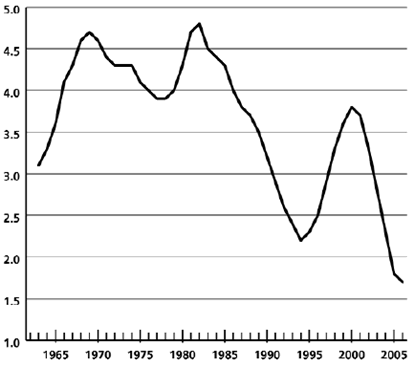
In much of the Western world the rate of profit of non-financial corporations fell steeply between 1950–73 and 2000–06—in the US, by roughly a quarter. In response, firms ‘invested’ increasingly in financial speculation, and the us government helped offset the resulting shortfall of non-residential private investment by boosting military spending (the Pentagon’s annual budget happens to be around the same as the figure put on the Treasury’s recent rescue plan).

(...) For a decade, the combined tails of the housing market and financial sector have wagged the dog of the British economy. As in the us, consumption grew much faster than gdp, financed by rising debt, thanks to booming house prices. A grateful electorate returned the Labour government to office twice in a row.


(...) For a decade, the combined tails of the housing market and financial sector have wagged the dog of the British economy. As in the us, consumption grew much faster than gdp, financed by rising debt, thanks to booming house prices. A grateful electorate returned the Labour government to office twice in a row.


Friday’s currency turmoil and stock market plunge was a case of the chickens coming home to roost from the class-war policies being waged by European and Asian industry and banking squeezing their domestic consumer markets – that is, labor’s living standards – in favor of export production to the United States. The internal contradiction in this industrial and financial class warfare is now clear: To the extent that it succeeds in depressing labor’s income, it stifles the domestic consumer-goods market. This disrupts Say’s Law – the principle that “production creates its own demand,” based on the assumption that employees will (or must) be paid enough to buy what they produce.
(...) This is not to say that no class warfare is being fought in the United States. Indeed, living standards for most wage earners today are down from the “golden age” of the late 1970s. But the U.S. economy had its own financial deus ex machina to soften the blow: Alan Greenspan’s asset-price inflation that flooded the banks with credit, which was lent out to homebuyers and stock market raiders. Rising home prices were applauded as “wealth creation” as if they were a pure asset, much like dividends suddenly being awarded to one’s savings account. Homebuyers were encouraged to “cash out” on the rising “equity” margin, the (temporarily) rising market price of their homes over and above their (permanent) mortgage debt. So while most mortgage money was used to bid up the price of home ownership, about a quarter of new lending was reported to be spent on consumption goods. Credit card debt also soared. In the face of a paycheck squeeze, U.S. consumers were maintaining their living standards by running further and further into debt.
(...) To understand the dynamics at work, one needs to look at the balance of payments – not so much the balance of trade itself, but the currency speculation, international lending and arbitrage that has dominated exchange rates over the past two decades. Exchange rates no longer reflect relative wage levels, “purchasing power parity” or living costs as in times past. Today, they reflect the flow of international borrowing where interest rates are low and lending at a markup where credit is tight – and then hedging this arbitrage, and jumping on the bandwagon to speculate on which way currencies will go.
(...) [carry trade] Hundreds of billions of dollars, euros and sterling worth of yen were borrowed and duly converted into foreign currencies to lend out at a markup. Arbitrageurs made billions by acting as financial intermediaries making income on the margin between low yen-borrowing costs and high foreign-currency interest rates. As Ambrose Evans-Pritchard wrote over a year ago in the Financial Times, “the Bank of Japan held interest rates at zero for six years until July 2006 to stave off deflation. Even now, rates are still just 0.5 per cent. It also injected some $12bn liquidity every month by printing money to buy bonds. The net effect has been a massive leakage of money into the global economy. Faced with a pitiful yield at home, Japan's funds and thrifty grannies shoveled savings abroad. Banks, hedge funds, and the proverbial Mrs Watanabe, were all able to borrow for near nothing in Tokyo to snap up assets across the globe. BNP Paribas estimates this "carry trade" to be $1,200bn.”
(...) As global currency markets no longer provide the easy pickings of the last decade, the yen carry trade is being wound down. This involves converting Icelandic currency, euros, sterling and other non-Japanese currencies back into yen to settle the debts owed to Japanese banks. This repayment – and hence re-conversion into yen – is pushing the yen’s price up. This threatens to make Japanese exports higher-priced in terms of dollars, euros and sterling. Last week, Sony forecast that its earnings will fall as a result, and other Japanese companies face a similar squeeze in sales, not only from rising yen/dollar prices but from the global slowdown resulting from two decades of pro-financial anti-labor economic policies.
(...) The soaring yen and plunging foreign currency rates are the result of unwinding the Japanese “carry trade” strategy to rescue its banks. Japanese industry will pay the bill. And despite the fall in sterling and the euro, Europe’s policy of emphasizing exports to the American market rather than to sell to its own domestic labor force looks pretty bad in view of the imminent economic slowdown in store. U.S. consumer spending and living standards will have to fall – and it seems, to fall sharply – in order to finance the “trickle down” economy at the top. Current Treasury policy is to bail out the creditors, not the debtors. The banks are being saved, but not U.S. industry, and certainly not the U.S. wage earner/consumer. Instead of pursuing a Keynesian type of deficit spending in a manner that will increase employment (government spending on goods and services, infrastructure spending and transfer payments), the Treasury and Federal Reserve are providing money to the banks to buy each other up, consolidating the U.S. financial system into a European-type system with only a few major banks. The financial system is to become monopolized and trustified, reversing two centuries of economic policy aimed at preventing financial dominance of the economy.
(...) Seeing the imminent shrinkage of the U.S. market, lenders and investors are dumping their shares, not only those of U.S. firms but also stocks in European and Asian export sectors. This is the “inner contradiction” of today’s financial rescue operation. Finance itself cannot survive in the face of a stifled domestic “real” economy.
(...) [the crux] So the world ought to be at an ideological turning point. But the last thing that Europe’s oligarchy wants to see is higher labor standards. Nor does the U.S. financial class. Europe and Asia put their faith in a U.S. consumer-goods market rather than their own. The U.S. financial sector found this appealing as long as consumption was financed by running into debt, not by workers earning more money or paying lower taxes. Industrial and political leaders throughout the world have been so anti-labor that there is little thought of raising domestic living standards via higher wage levels and a tax shift off labor and industry back onto property where progressive tax policies used to be based.
(...) As foreign exporters are rudely awakened the dream of an American demand, when will the point come at which Europe and Asia seek to build up their own domestic consumer markets as an alternative? The first problem is to overcome the ideological bias in which central bankers are indoctrinated, in a world where politicians have relinquished economic policy to bankers trained in Chicago School financial warfare against labor and even against industry. It probably is too much to hope that today’s European central bankers and kindred economic managers will drop their neoliberal anti-labor ideology and see that without a thriving domestic market, their own industrial firms will languish. The solution must come from a revived political sector representing the interests of labor, and even of industry itself as it sees the need to revive domestic markets.
(...) This is not to say that no class warfare is being fought in the United States. Indeed, living standards for most wage earners today are down from the “golden age” of the late 1970s. But the U.S. economy had its own financial deus ex machina to soften the blow: Alan Greenspan’s asset-price inflation that flooded the banks with credit, which was lent out to homebuyers and stock market raiders. Rising home prices were applauded as “wealth creation” as if they were a pure asset, much like dividends suddenly being awarded to one’s savings account. Homebuyers were encouraged to “cash out” on the rising “equity” margin, the (temporarily) rising market price of their homes over and above their (permanent) mortgage debt. So while most mortgage money was used to bid up the price of home ownership, about a quarter of new lending was reported to be spent on consumption goods. Credit card debt also soared. In the face of a paycheck squeeze, U.S. consumers were maintaining their living standards by running further and further into debt.
(...) To understand the dynamics at work, one needs to look at the balance of payments – not so much the balance of trade itself, but the currency speculation, international lending and arbitrage that has dominated exchange rates over the past two decades. Exchange rates no longer reflect relative wage levels, “purchasing power parity” or living costs as in times past. Today, they reflect the flow of international borrowing where interest rates are low and lending at a markup where credit is tight – and then hedging this arbitrage, and jumping on the bandwagon to speculate on which way currencies will go.
(...) [carry trade] Hundreds of billions of dollars, euros and sterling worth of yen were borrowed and duly converted into foreign currencies to lend out at a markup. Arbitrageurs made billions by acting as financial intermediaries making income on the margin between low yen-borrowing costs and high foreign-currency interest rates. As Ambrose Evans-Pritchard wrote over a year ago in the Financial Times, “the Bank of Japan held interest rates at zero for six years until July 2006 to stave off deflation. Even now, rates are still just 0.5 per cent. It also injected some $12bn liquidity every month by printing money to buy bonds. The net effect has been a massive leakage of money into the global economy. Faced with a pitiful yield at home, Japan's funds and thrifty grannies shoveled savings abroad. Banks, hedge funds, and the proverbial Mrs Watanabe, were all able to borrow for near nothing in Tokyo to snap up assets across the globe. BNP Paribas estimates this "carry trade" to be $1,200bn.”
(...) As global currency markets no longer provide the easy pickings of the last decade, the yen carry trade is being wound down. This involves converting Icelandic currency, euros, sterling and other non-Japanese currencies back into yen to settle the debts owed to Japanese banks. This repayment – and hence re-conversion into yen – is pushing the yen’s price up. This threatens to make Japanese exports higher-priced in terms of dollars, euros and sterling. Last week, Sony forecast that its earnings will fall as a result, and other Japanese companies face a similar squeeze in sales, not only from rising yen/dollar prices but from the global slowdown resulting from two decades of pro-financial anti-labor economic policies.
(...) The soaring yen and plunging foreign currency rates are the result of unwinding the Japanese “carry trade” strategy to rescue its banks. Japanese industry will pay the bill. And despite the fall in sterling and the euro, Europe’s policy of emphasizing exports to the American market rather than to sell to its own domestic labor force looks pretty bad in view of the imminent economic slowdown in store. U.S. consumer spending and living standards will have to fall – and it seems, to fall sharply – in order to finance the “trickle down” economy at the top. Current Treasury policy is to bail out the creditors, not the debtors. The banks are being saved, but not U.S. industry, and certainly not the U.S. wage earner/consumer. Instead of pursuing a Keynesian type of deficit spending in a manner that will increase employment (government spending on goods and services, infrastructure spending and transfer payments), the Treasury and Federal Reserve are providing money to the banks to buy each other up, consolidating the U.S. financial system into a European-type system with only a few major banks. The financial system is to become monopolized and trustified, reversing two centuries of economic policy aimed at preventing financial dominance of the economy.
(...) Seeing the imminent shrinkage of the U.S. market, lenders and investors are dumping their shares, not only those of U.S. firms but also stocks in European and Asian export sectors. This is the “inner contradiction” of today’s financial rescue operation. Finance itself cannot survive in the face of a stifled domestic “real” economy.
(...) [the crux] So the world ought to be at an ideological turning point. But the last thing that Europe’s oligarchy wants to see is higher labor standards. Nor does the U.S. financial class. Europe and Asia put their faith in a U.S. consumer-goods market rather than their own. The U.S. financial sector found this appealing as long as consumption was financed by running into debt, not by workers earning more money or paying lower taxes. Industrial and political leaders throughout the world have been so anti-labor that there is little thought of raising domestic living standards via higher wage levels and a tax shift off labor and industry back onto property where progressive tax policies used to be based.
(...) As foreign exporters are rudely awakened the dream of an American demand, when will the point come at which Europe and Asia seek to build up their own domestic consumer markets as an alternative? The first problem is to overcome the ideological bias in which central bankers are indoctrinated, in a world where politicians have relinquished economic policy to bankers trained in Chicago School financial warfare against labor and even against industry. It probably is too much to hope that today’s European central bankers and kindred economic managers will drop their neoliberal anti-labor ideology and see that without a thriving domestic market, their own industrial firms will languish. The solution must come from a revived political sector representing the interests of labor, and even of industry itself as it sees the need to revive domestic markets.
Tuesday, May 27, 2008
breaking the chains:
For every $1 that developing countries receive from rich countries in aid, they return $5 in debt repayments.
(...) [a nice, simple, succinct explanation] The genesis of the crisis lies in a world economy saturated by dollars in the 1960s and ’70s, as the dollar replaced gold as the currency of exchange, and the world paid for a growing US budget deficit.When oil-exporting countries in OPEC reduced oil supply in 1973 and oil prices soared, much of this profit was again deposited in dollars in Western banks. Banks, eager to reduce the supply of dollars, to prevent a collapse in the dollar price and to make profit, lent out more money to developing countries, many of which were newly liberated from colonialism. Little thought was given to how useful these loans were or to whom they were being lent. Then, Ronald Reagan came to power in the US. Interest rates soared and the price of commodities, on which many poor countries depended, slumped. Poor countries earned less for their exports and paid more interest on their loans. They had to borrow more simply to repay the interest. The debt crisis was born.
(...) Haiti still owes $1.3bn to international creditors like the World Bank. Some 40 per cent of this was run up by Papa Doc and Baby Doc, who stole parts of these loans for themselves and used the rest to repress the population. When the US flew Baby Doc out of Haiti in 1986, he is estimated to have taken $90m with him.
(...) In 1995, the IMF forced Haiti to slash its rice tariff from 35 per cent to 3 per cent, enriching US business through soaring imports. A country that was self-sufficient in rice is now dependent on foreign imports at the mercy of global market prices.
(...) The Suharto regime in Indonesia was reputed to be one of the most corrupt and brutal governments in modern times. Suharto stole up to $35bn from his country and killed up to 1 million people in political witch-hunts, yet the World Bank still lent it $30bn. Today, the Indonesian people continue to pay $2m every hour for their former dictator’s debt, while 100 million Indonesians live in poverty.
For every $1 that developing countries receive from rich countries in aid, they return $5 in debt repayments.
(...) [a nice, simple, succinct explanation] The genesis of the crisis lies in a world economy saturated by dollars in the 1960s and ’70s, as the dollar replaced gold as the currency of exchange, and the world paid for a growing US budget deficit.When oil-exporting countries in OPEC reduced oil supply in 1973 and oil prices soared, much of this profit was again deposited in dollars in Western banks. Banks, eager to reduce the supply of dollars, to prevent a collapse in the dollar price and to make profit, lent out more money to developing countries, many of which were newly liberated from colonialism. Little thought was given to how useful these loans were or to whom they were being lent. Then, Ronald Reagan came to power in the US. Interest rates soared and the price of commodities, on which many poor countries depended, slumped. Poor countries earned less for their exports and paid more interest on their loans. They had to borrow more simply to repay the interest. The debt crisis was born.
(...) Haiti still owes $1.3bn to international creditors like the World Bank. Some 40 per cent of this was run up by Papa Doc and Baby Doc, who stole parts of these loans for themselves and used the rest to repress the population. When the US flew Baby Doc out of Haiti in 1986, he is estimated to have taken $90m with him.
(...) In 1995, the IMF forced Haiti to slash its rice tariff from 35 per cent to 3 per cent, enriching US business through soaring imports. A country that was self-sufficient in rice is now dependent on foreign imports at the mercy of global market prices.
(...) The Suharto regime in Indonesia was reputed to be one of the most corrupt and brutal governments in modern times. Suharto stole up to $35bn from his country and killed up to 1 million people in political witch-hunts, yet the World Bank still lent it $30bn. Today, the Indonesian people continue to pay $2m every hour for their former dictator’s debt, while 100 million Indonesians live in poverty.
Thursday, May 24, 2007
god bless america:
First in Oil Consumption:
The United States burns up 20.7 million barrels per day, the equivalent of the oil consumption of China, Japan, Germany, Russia, and India combined.
First in Carbon Dioxide Emissions:
Each year, world polluters pump 24,126,416,000 metric tons of carbon dioxide (CO2) into the environment. The United States and its territories are responsible for 5.8 billion metric tons of this, more than China (3.3 billion), Russia (1.4 billion) and India (1.2 billion) combined.
First in External Debt:
The United States owes $10.040 trillion, nearly a quarter of the global debt total of $44 trillion.
First in Military Expenditures:
(...)Military analyst Winslow Wheeler did the math recently: "Add $142 billion to cover the anticipated costs of the wars in Iraq and Afghanistan; add $17 billion requested for nuclear weapons costs in the Department of Energy; add another $5 billion for miscellaneous defense costs in other agencies.... and you get a grand total of $647 billion for 2008."
First in Weapons Sales:
Since 2001, U.S. global military sales have normally totaled between $10 and $13 billion. That's a lot of weapons, but in fiscal year 2006, the Pentagon broke its own recent record, inking arms sales agreements worth $21 billion.
(...)After all, what does a drug dealer do? He creates a need and then fills it. He encourages an appetite or (even more lucratively) an addiction and then feeds it. Arms dealers do the same thing. They suggest to foreign officials that their military just might need a slight upgrade. After all, they'll point out, haven't you noticed that your neighbor just upgraded in jets, submarines, and tanks? And didn't you guys fight a war a few years back? Doesn't that make you feel insecure? And why feel insecure for another moment when, for just a few billion bucks, we'll get you suited up with the latest model military... even better than what we sold them -- or you the last time around. Why does Turkey, which already has 215 fighter planes, need 100 extras in an even higher-tech version? It doesn't... but Lockheed Martin, working the Pentagon, made them think they did.
First in Oil Consumption:
The United States burns up 20.7 million barrels per day, the equivalent of the oil consumption of China, Japan, Germany, Russia, and India combined.
First in Carbon Dioxide Emissions:
Each year, world polluters pump 24,126,416,000 metric tons of carbon dioxide (CO2) into the environment. The United States and its territories are responsible for 5.8 billion metric tons of this, more than China (3.3 billion), Russia (1.4 billion) and India (1.2 billion) combined.
First in External Debt:
The United States owes $10.040 trillion, nearly a quarter of the global debt total of $44 trillion.
First in Military Expenditures:
(...)Military analyst Winslow Wheeler did the math recently: "Add $142 billion to cover the anticipated costs of the wars in Iraq and Afghanistan; add $17 billion requested for nuclear weapons costs in the Department of Energy; add another $5 billion for miscellaneous defense costs in other agencies.... and you get a grand total of $647 billion for 2008."
First in Weapons Sales:
Since 2001, U.S. global military sales have normally totaled between $10 and $13 billion. That's a lot of weapons, but in fiscal year 2006, the Pentagon broke its own recent record, inking arms sales agreements worth $21 billion.
(...)After all, what does a drug dealer do? He creates a need and then fills it. He encourages an appetite or (even more lucratively) an addiction and then feeds it. Arms dealers do the same thing. They suggest to foreign officials that their military just might need a slight upgrade. After all, they'll point out, haven't you noticed that your neighbor just upgraded in jets, submarines, and tanks? And didn't you guys fight a war a few years back? Doesn't that make you feel insecure? And why feel insecure for another moment when, for just a few billion bucks, we'll get you suited up with the latest model military... even better than what we sold them -- or you the last time around. Why does Turkey, which already has 215 fighter planes, need 100 extras in an even higher-tech version? It doesn't... but Lockheed Martin, working the Pentagon, made them think they did.
Saturday, April 28, 2007
hunger and capitalism [important statistics and quotes, but poor article]:
Nearly 16 million Americans are living in deep or severe poverty.
(...) "A McClatchy Newspapers analysis of the 2005 census figures, the latest available, found that nearly 16 million Americans are living in extreme poverty. A family of four with two children and an annual income of less than $9,903 — half the federal poverty line — was considered severely poor in 2005. So were individuals who made less than $5,080 a year."
(...) Professor Jean Ziegler (UN Special Rapporteur on the Right to Food and author of various books on globalization and on what he calls the crimes committed in the name of global finance and capitalism) attests in his book 'L'empire de la honte' (Editions Fayard – 'Empire of Shame', translated in 14 languages but not in English) that enough food can be provided globally for twice the number of the current world population of 6.6 billion.
(...) "Through the [international] debt, hunger is the weapon of mass destruction which is used by the cosmocrats to crush - and to exploit - the people, in particular in the Southern hemisphere."[…]" A complex set of measures, immediately feasible and which I describe in the book, could quickly put a term to hunger. It is impossible to sum these up in one sentence. One thing is certain: world agriculture, in the current state of productivity, could feed twice the number of today’s global population. So it is not a matter of fate: hunger is man made.
Nearly 16 million Americans are living in deep or severe poverty.
(...) "A McClatchy Newspapers analysis of the 2005 census figures, the latest available, found that nearly 16 million Americans are living in extreme poverty. A family of four with two children and an annual income of less than $9,903 — half the federal poverty line — was considered severely poor in 2005. So were individuals who made less than $5,080 a year."
(...) Professor Jean Ziegler (UN Special Rapporteur on the Right to Food and author of various books on globalization and on what he calls the crimes committed in the name of global finance and capitalism) attests in his book 'L'empire de la honte' (Editions Fayard – 'Empire of Shame', translated in 14 languages but not in English) that enough food can be provided globally for twice the number of the current world population of 6.6 billion.
(...) "Through the [international] debt, hunger is the weapon of mass destruction which is used by the cosmocrats to crush - and to exploit - the people, in particular in the Southern hemisphere."[…]" A complex set of measures, immediately feasible and which I describe in the book, could quickly put a term to hunger. It is impossible to sum these up in one sentence. One thing is certain: world agriculture, in the current state of productivity, could feed twice the number of today’s global population. So it is not a matter of fate: hunger is man made.
Monday, April 23, 2007
the UK economy propped up by big business, skating on thin ice:
"The UK's current deficit has reached 3.5 per cent of GDP which suggests that as a country we are close to the edge. Ultimately, we are all skating - not to say wobbling - on thin ice. There's a danger that we are slithering into complacency." Britain's consumer debt mountain has topped £1.3 trillion, raising fears that thousands of households will be left with debts they cannot afford to repay if interest rates are jacked up. Shock figures last week showing inflation had jumped to a 10-year high of 3.1 per cent, prompted some analysts to predict that rates might have to rise from their current 5.25 per cent to 6 per cent.
"The UK's current deficit has reached 3.5 per cent of GDP which suggests that as a country we are close to the edge. Ultimately, we are all skating - not to say wobbling - on thin ice. There's a danger that we are slithering into complacency." Britain's consumer debt mountain has topped £1.3 trillion, raising fears that thousands of households will be left with debts they cannot afford to repay if interest rates are jacked up. Shock figures last week showing inflation had jumped to a 10-year high of 3.1 per cent, prompted some analysts to predict that rates might have to rise from their current 5.25 per cent to 6 per cent.
Subscribe to:
Posts (Atom)