
Showing posts with label financial capital. Show all posts
Showing posts with label financial capital. Show all posts
Sunday, February 7, 2010
What’s wrong with this scheme? Several things. First, many small banks have more money than they can profitably invest locally. As Barbara Garson shows in her wonderful book, Money Makes the World Go Around, the portion of her book advance she deposited in tiny upstate New York bank was probably lent via the fed funds market to Chase, where it entered the global circuit of capital. This is not at all uncommon. Money is fungible, protean, and highly mobile even when it looks locally rooted. That very mutability is part of what makes money so valuable: it’s the ideal form of general wealth that can instantly be turned into caviar, lodging, Swedish massage, or shares of Google.

Thursday, October 22, 2009
saskia sassen, the global city
xix-xxii: the seven hypotheses
(1) - geographic dispersal of economic activities is a key factor feeding the importance of central corporate functions;
(2) - central functions are so complex that large global firms are compelled to outsource them to 'highly specialized service firms.'
(3) - these highly specialized service firms are 'subject to agglomeration economies.' as a result, "global cities are, in this regard, production sites for the leading information industries of our time."
(4) - the more headquarters outsource their most complex functions, "the freer they are to opt for any location" for the work actually done in their headquarters;
(5) - specialized service firms are engaged in providing a 'global service,' which encourages global city-global city partnership;
(6) - a growing number of high level professionals in cities "have the effect of raising the degree of spatial and socioeconomic inequality evident in these cities."
(7) - the dynamics described in hypothesis six lead to "the growing informalization of a range of economic activities..."
(3): cities' four-fold new functions: (1) highly concentrated command points; key locations for finance; (3) sites of production of innovations; (4) markets for the products and innovations of this new services economy.
(5): "the fundamental dynamic posited here is that the more globalized the economy becomes, the higher the agglomeration of central functions in a relatively few sites, that is, in global cities... there is a new logic of concentration."
(5): the "global city" as a site of production of "highly specialized services and financial goods" [note, this does not tell us anything about cities, in general--in that sense the explanandum is not the "urban," but an atypical subset]
(6): wanting to focus on the "practice" of global control--"the work of producing and reproducing the organization and management of a global production system and a global marketplace for finance," a process in which the "global city" has a critical role. [she is less interested, she says, in the 'familiar issues' of the power of larger corporations. but is this simply an excuse to dull the heinousness of what she's describing?]
(8): question, also, about the relationship between the city and the nation-state
(10): and finally, the morphology of the new service sector--what about the low-wage jobs that supply this high-wage service sector?
(12): important--here some reflections on why this transition has happened, and how to theorize it. it is not the case that new industries have emerged to replace old ones; at least it is not that simple. what has happened, instead, is a "deep structural process of decline," in which "growth" and "decline" have to be theorized more holistically. simply and specifically, i guess, this is the idea that we are seeing the geographic dispersal of manufacturing, which has engendered the need for the new. [the question, though, is why we need to see the 80's and 90's as "high-flying," rather than periods of stagnation. this motivates a question re: whether the change she is documenting can be attributed to technological shifts, as is somewhat implied, or whether there's something else, more internal to the pure dynamics of capitalism, which has spurred it. i suppose the two theorizations are not mutually exclusive, but there is a sense in which sassen has evacuated the latter paradigm from her analysis.]
(12-13): more on the systemic connection between 'decline' and 'growth'. four working hypotheses:
(1) geographic dispersal of manufacturing, which contributed to the decline of old industrial center [and] [created] a demand for expanded central management...
(2) the growth of the financial industry... benefited from policies and conditions often harmful to other industrial sectors, notably manufacturing (do we mean hiking the interest rates in '79?)
(3) "a transformation in the economic relationships among global cities, the nation states where they are located, and the world economy..."
(4) a "new class alignment" in the global city [a species of "structured coherence," perhaps?]
(19): it might be important to clarify the causal connections between these three observations, because elsewhere it seems to be distinct from what she is proposing here: "a leading argument in this book is that the spatial dispersion of economic activities and the reorganization of the financial industry are two processes that have contributed to new forms of centralization insofar as they have occurred under conditions of continued concentration in ownership or control." [recall panitch and gindin, in other words, who suggest that 'the reorganization of the financial industry' was necessary for Capital to come to terms with 'transnationalization'. also, is the last clause suggesting a positive, normative project--that this process could (and should) have happened under different "conditions [of] ... ownership [and] control."
(20): what we have seen, in effect, is a de-centering of transnational banks (and the TNC's, of course), and the concomitant rise of the "major centers of finance."
(19): interesting, if cryptic sentence: "whether internationalization is essential to the major outcomes, notably the acute pressure, toward agglomeration in leading cities, is difficult to establish and is perhaps a question of theory." [what to make of this? we can have the global city without globalization? unlikely. but this is why her doing the work of theory would be immensely helpful; is she eschewing that task even though she thinks it worthwhile?]
(20): question of the concept of "productive innovation" in finance, insofar as she is anticipating the possibility of "non-productive innovation." what is the distinction? hasn't recent history proven the fallacies of celebrating precisely this same fact of innovation, insofar as it has proved to be 'smoke' and 'mirrors'? or are we speaking of a subset of the kind of innovation that she wants to speak about. [my position seems justified--"innovations" are made explicit on page 21 as "derivatives" and "hedge funds"]
(21): explicitly naming the 'long wave' objection (what is different about this round of 'financialization' from what transpired at the turn of the century?)
chapter two
(23): "capital mobility" is not simply the ability of capital to move across space; the concept must also assimilate the fact of increasing centralization.
(26): mention of 'transnationalization' as a political strategy to break 'fordism', but also a technical consequence of new strategies that were "designed to separate low-wage, routine tasks from highly skilled tasks..."
(28-29): seems too lumpy -- discussing "transnationalization" at the same time as mentioning how many women work from their suburban homes? i understand the affinity, but could this not be said to be symptomatic of some larger failings to systematize data with an appropriately theoretical frame?
(30): sassen's notion of the "redeployment of growth poles," which helps us observe that geographic dispersal has gone hand-in-hand with increasing concentration of capital ["such a parallel decentralization of ownership has not taken place. The large size of firms has made it possible to internalize transaction and circulation costs, thereby reducing the barriers to capital circulation and raising capital's ability to equalize the profit rate." [marxist commitments, clearly...]
(31): perhaps we can start, here, to ask what "productive innovation" in finance might mean? "opening up of regional markets"; "offshore banking" --> all leading to a "renewed concentration in and orientation toward major financial centers, beginning in the early 1980s... not mere geographic retrenchment but was in fact associated with new forms of capital mobility..." "The central activity is now the buying and selling of instruments over and over again, thereby maximizing the circulation of financial capital.."
(32): "increased capital mobility has brought about a homogenization of economic space..." [but, in a way compatible with uneven development, of course.]
(32): important--quite bleak implication for one type of development strategy, here. peripheral labor can now be employed without ever escaping its peripherality. no more "labor aristocracy," which she identifies as a very specific historical phenomenon. technological/communication revolution has enabled high-tech industries to incorporate sweatshop labor. this tendency towards dispersal, she's implying, "neutralizes the politico-economic consequences that Marx associated with the generalized increase in the capital intensity of production..."
(33): labor in this service economy, more mobile/transnational/unequal -- (1) both highly trained personnel, and (2) unskilled service labor
(33-36): useful summary of argument of chapter 2
chapter 10: a new urban regime?
(329): "the most pronounced development is the massive increase in the volume of transactions of the financial industry, by far the most significant international industry."
(330): "most foreign direct investment is now in services."
(331): "the weight of economic activity since the 1980s has shifted from production places, such as Detroit and Manchester, to centers of finance and highly specialized services."
(331): her central amendment to a traditional 'world-systems' narrative--the need for 'control'/'organization' is not inherent in fragmentation ("cannot be taken for granted") but needs to be produced.
(331): "global cities as sites for the production of global control capability."
(332): a list of the kind of firms that comprise this "global control capability"--isn't this a bit underwhelming, if we're honest? -- "advertising, accounting, legal services, business services, certain types of banking, engineering, and architectural services."
(332): hmm--on the one hand she is drawing attention to the enormous importance of finance, as service. but on the other hand, she doesn't want to include the production of financial instruments as a "service." the question, then, is obvious: is the popular narrative that it is these instruments and the games they play that account for the enormity of financial activity? or is it actually true that the services that actually comprise global control capability dominate the world economy? the latter seems very counter-intuitive, especially if you consider the amount of money that was trading on the derivatives market (220 trillion dollars, or something like this...), and all this. having said this, it does seem like she acknowledges this, to an extent; i would only say that what i've read of her argument does not foreground the parasitism of this fact.
(332): the potential for other global cities, besides the trinity -- the possibility of regional and national markets that need a more locally-oriented site of control capability.
(333): and KEY--her larger argument assimilates the understanding that manufacture and the proletariat, in fact, HAVE NOT declined. "I argue it is these transformations that constitute the shift to a service-dominated economy, rather than the mere fact of a shift in employment from manufacturing to services, a process usually centered on the growth of consumer services. On the contrary, I posit that the period of massive growth of consumer services is associated with the expansion of mass production in manufacturing." [but this does raise the question: why do we need to speak about this as "an economic system dominated by such management, servicing, and financial activities? see page 334] see also discussion below
(333): between the global cities, the emergence of a "transterritorial economy" [though not, at all, a self-sufficient economy, remember--it could not exist without manufacturing]
(334): important--an explicit consideration of the place of manufacturing economy. and again, the implications are bleak, insofar as they portend an increasing divergence between the fortunes of the global city and the nation. "Yes, manufacturing matters, but from the perspective of finance and producer services, it does not have to be national... One of the key points developed in this book is that much of the new growth rests on the decline of what were once significant sectors of the national economy, notably key branches of manufacturing that were the leading force in the national economy and promoted the formation and expansion of strong middle class."
(335): MOST IMPORTANT--new, more severe forms of "increased social and economic polarization" associated with this transformation. and this, of course, may one day call into question the foundations of the new growth, too. "At what point do these tensions become unbearable? At what point is the fact of homelessness a cost also for the leading growth sectors? How many times do high-income executives have to step over the bodies of homeless people till this becomes an unacceptable fact or discomfort? At what point does the increasing poverty of large numbers of workers begin to interfere with the performance of the core industries either directly or indirectly? It is perhaps the social involution that this mode of growth brings about in significant sectors of a national economy that may be more devastating to its own growth than the decline of manufacturing at the national level, since there is significant manufacturing growth globally, and in that sense there is grist for the mill of the producer services complex."
(335-336): and then, also, the obvious tension between the "growth of these leading 'industries'" and the decline of the health of the nation-state (in burgeoning budget deficits due to the decline of national economic sectors)
(336): barriers to entry, which is critical for the absurd hacks who want to transform this into a normative project ("And most cities lack the mix of resources which creates organizational complexity in leading cities. We are entering a whole new phase in the development of urban economic cities.")
(337-338): narrative of suburbanization and the rise of the middle-class in the US; in UK, "social provisioning" in the form of a "national public health system" and "public housing"; in Japan, "massive reinvestment to expand the infrastructure for production rather than that for social reproduction."
(339): a move away from production for internal consumer markets, and towards international markets as symptomatic of the larger shift away from the Fordist phase.
(340): IMPORTANT, even if she doesn't answer it, she is asking exactly the right question, here: "This development [away from Fordism] raises a number of questions about the intersection of economics and politics and about the 'natural' tendencies of capitalist economies. Was the social compact of the postwar period the result of the weight of local politics in a phase of economic development that gave local claims unusual powers? And is what we are seeing today--increased economic and social polarization--the 'natural' outcome of the operation of the economic system when political claims carry little weight?"
(340): identifiying an "ideology of globalism," within which "localities are seen as powerless in an era of global economic forces."
(340-341): important--high-income workers vs. management of these service industries--argument, here, is that there is an important distinction to be drawn between the two. the former have no claims over their places of work; they can be fired at the drop of the hat. they are tied to it through "conspicuous consumption," which "serves a strong ideological function of securing the alliance of these workers." [many questions, of course, but perhaps useful to use this as a way into the question of "productive" and "unproductive" labor -- the argument is that "they are ultimately a stratum of extremely hard-working people whose alliance to the system leads them to produce far more profit than they get back in their admittedly very high salaries and bonuses." but how? is their labor not more destructive, than productive, insofar as they're engaged in the re-distribution of surplus value? or are they actually 'facilitating' the creation of 'surplus-value'? or perhaps these two are not mutually exclusive?
(341): let's not overplay the role of these people, as a mass, in the larger population. she acknolwedges that they are "numerically small", but seems to peg the prominence of a "new social aesthetic" to their rise, nonetheless. i suppose we'll have to admit that this culture exists, of course; though it's prominence is open to contestation. they are certainly not involved in an active "war of position." they don't care about winning "hearts and minds." clearly, with sassen, we are still justified in deriding this as the culture of an unaccountable and seceding elite.
(343): all this, again, seems to represent a "new urban regime" [what does this mean, though--theoretically--for questions re: its stability?]
(344): again, engaging the earlier question of the role of finance--how to make sense of this, exactly? ("This is not to say that finance was unimportant then and manufacturing is unimportant today. Nor is it simply that the financial industry has replaced the auto industry as the leading economic force.
epilogue
(346): there are six sets of debates
(1) re: the global city as model (347-355);
(2) re: place and role of finance
(3) producer services;
(4) relations among cities;
(5) inequality in global cities;
(6) are global cities a new spatial order?
(347): concept of "incipient de-nationalization" -- is this helpful? elites willingly surrendering the state to capital?
(348): no such entity as a single global city--"the global city is a function of cross border network of strategic sites... The global city network is the operational scaffolding of that other fuzzy notion, the global economy."
(349): she is not assuming homogenization--rather, her point is "the development and partial importation of a set of specialized functions and the direct and indirect effects this may have on the larger city."
(349): what work does this distinction do, exactly--"It is not simply a matter of global coordination but one of the production of global control capacities."
(349): she is concerned, after all, with a "whole infrastructure of jobs typically not marked as belonging to the corporate sector of the economy."
(350): "The place-ness of the global city is a crucial theoretical and methodological issue in my work. Theoretically it captures Harvey's notion of capital fixity as necessary for hypermobility."
(350): important--she understands herself as making a "distinction between what is encompassed by the global city model and the larger urban entity called New York... What may have not been stated with adequate clarity... is that the effort... was to understand the impact of the global city function on the larger city, to see whether this impact is beneficial for a larg sector of the population or not..." [i think we can push this much, much further than she has--and then, having done that, doesn't it destabilize much of what is 'formally' advertised in this book?]
(351): one answer to why this prism of the global city is useful (again, though, not because it might tell us about cities, but because it tells us something specific about the global economy): "The concept of the global city introduces a far stronger emphasis on strategic components of the global economy, and hence on questions of power... Overall, I would say, the concept of the global city is more attuned to questions of power and inequality."
(354): speaking, explicitly, of "the global city," as it exists today, as a construction of today--"one of the marking features of the organizational architecture of the current phase" of capitalism.
(358): "indeed it let me to start a major new multiyear project on the role of the state in globalization and the impact of the latter in altering the logic explaining whose claims become legitimate"
(358): acknowledging that 1980s and 1990s "increasingly delinked finance from its role as servicing the 'real' economy." and also that financial turn "is not the first time this happens in recent Western history..." "But in my reading there are distinctive features that differentiate the current phase rom earlier phases."
(360): KEY, responds to the questions I posed earlier--"what is specific about the shift to services is not merely the growth in service jobs but, most importantly, the growing service intensity in the organization of advanced economies: firms in all industries, from mining to wholesale buy more accounting, legal, advertising, financial, economic forecasting services, and so on, today than they did twenty years ago... Cities emerge as important production sites for what are key inputs for firms in all industries."
- - - - - - - - - - - - - - - - - - - - -
neil brenner critique in "review of international political economy" (1,1, 1998)-- reference point of sassen's concept of "systemic discontinuity" is a static nation-space; she has not seen how the reconfiguration of the state, itself, is concomitant to the same processes that have shaped the city. thus her conclusions about the state suffer because they reify an earlier, temporary form, in effect (he is drawing attention, instead, to regional configurations--not unlike taylor).
peter taylor critique in "review of international political economy" (1, 2, 1994)--sassen misses three things: (1) the focus on three cities is inadequate for an understanding of the world urban hierarchy; (2) her theorization of the state is absent, rigid, inadequate--he wants to mention the possibility that different states will take different tactics re: the production of the global city; (3) her theorization of the 1980s runs roughshod over the realization problem; in effect, taylor is drawing attention to the contradiction of neoliberal restructuring (capital will still need to find a market for its goods). this is why he thinks it is the 1980s that are temporary, rather than the social democratic solution of yesteryear.
xix-xxii: the seven hypotheses
(1) - geographic dispersal of economic activities is a key factor feeding the importance of central corporate functions;
(2) - central functions are so complex that large global firms are compelled to outsource them to 'highly specialized service firms.'
(3) - these highly specialized service firms are 'subject to agglomeration economies.' as a result, "global cities are, in this regard, production sites for the leading information industries of our time."
(4) - the more headquarters outsource their most complex functions, "the freer they are to opt for any location" for the work actually done in their headquarters;
(5) - specialized service firms are engaged in providing a 'global service,' which encourages global city-global city partnership;
(6) - a growing number of high level professionals in cities "have the effect of raising the degree of spatial and socioeconomic inequality evident in these cities."
(7) - the dynamics described in hypothesis six lead to "the growing informalization of a range of economic activities..."
(3): cities' four-fold new functions: (1) highly concentrated command points; key locations for finance; (3) sites of production of innovations; (4) markets for the products and innovations of this new services economy.
(5): "the fundamental dynamic posited here is that the more globalized the economy becomes, the higher the agglomeration of central functions in a relatively few sites, that is, in global cities... there is a new logic of concentration."
(5): the "global city" as a site of production of "highly specialized services and financial goods" [note, this does not tell us anything about cities, in general--in that sense the explanandum is not the "urban," but an atypical subset]
(6): wanting to focus on the "practice" of global control--"the work of producing and reproducing the organization and management of a global production system and a global marketplace for finance," a process in which the "global city" has a critical role. [she is less interested, she says, in the 'familiar issues' of the power of larger corporations. but is this simply an excuse to dull the heinousness of what she's describing?]
(8): question, also, about the relationship between the city and the nation-state
(10): and finally, the morphology of the new service sector--what about the low-wage jobs that supply this high-wage service sector?
(12): important--here some reflections on why this transition has happened, and how to theorize it. it is not the case that new industries have emerged to replace old ones; at least it is not that simple. what has happened, instead, is a "deep structural process of decline," in which "growth" and "decline" have to be theorized more holistically. simply and specifically, i guess, this is the idea that we are seeing the geographic dispersal of manufacturing, which has engendered the need for the new. [the question, though, is why we need to see the 80's and 90's as "high-flying," rather than periods of stagnation. this motivates a question re: whether the change she is documenting can be attributed to technological shifts, as is somewhat implied, or whether there's something else, more internal to the pure dynamics of capitalism, which has spurred it. i suppose the two theorizations are not mutually exclusive, but there is a sense in which sassen has evacuated the latter paradigm from her analysis.]
(12-13): more on the systemic connection between 'decline' and 'growth'. four working hypotheses:
(1) geographic dispersal of manufacturing, which contributed to the decline of old industrial center [and] [created] a demand for expanded central management...
(2) the growth of the financial industry... benefited from policies and conditions often harmful to other industrial sectors, notably manufacturing (do we mean hiking the interest rates in '79?)
(3) "a transformation in the economic relationships among global cities, the nation states where they are located, and the world economy..."
(4) a "new class alignment" in the global city [a species of "structured coherence," perhaps?]
(19): it might be important to clarify the causal connections between these three observations, because elsewhere it seems to be distinct from what she is proposing here: "a leading argument in this book is that the spatial dispersion of economic activities and the reorganization of the financial industry are two processes that have contributed to new forms of centralization insofar as they have occurred under conditions of continued concentration in ownership or control." [recall panitch and gindin, in other words, who suggest that 'the reorganization of the financial industry' was necessary for Capital to come to terms with 'transnationalization'. also, is the last clause suggesting a positive, normative project--that this process could (and should) have happened under different "conditions [of] ... ownership [and] control."
(20): what we have seen, in effect, is a de-centering of transnational banks (and the TNC's, of course), and the concomitant rise of the "major centers of finance."
(19): interesting, if cryptic sentence: "whether internationalization is essential to the major outcomes, notably the acute pressure, toward agglomeration in leading cities, is difficult to establish and is perhaps a question of theory." [what to make of this? we can have the global city without globalization? unlikely. but this is why her doing the work of theory would be immensely helpful; is she eschewing that task even though she thinks it worthwhile?]
(20): question of the concept of "productive innovation" in finance, insofar as she is anticipating the possibility of "non-productive innovation." what is the distinction? hasn't recent history proven the fallacies of celebrating precisely this same fact of innovation, insofar as it has proved to be 'smoke' and 'mirrors'? or are we speaking of a subset of the kind of innovation that she wants to speak about. [my position seems justified--"innovations" are made explicit on page 21 as "derivatives" and "hedge funds"]
(21): explicitly naming the 'long wave' objection (what is different about this round of 'financialization' from what transpired at the turn of the century?)
chapter two
(23): "capital mobility" is not simply the ability of capital to move across space; the concept must also assimilate the fact of increasing centralization.
(26): mention of 'transnationalization' as a political strategy to break 'fordism', but also a technical consequence of new strategies that were "designed to separate low-wage, routine tasks from highly skilled tasks..."
(28-29): seems too lumpy -- discussing "transnationalization" at the same time as mentioning how many women work from their suburban homes? i understand the affinity, but could this not be said to be symptomatic of some larger failings to systematize data with an appropriately theoretical frame?
(30): sassen's notion of the "redeployment of growth poles," which helps us observe that geographic dispersal has gone hand-in-hand with increasing concentration of capital ["such a parallel decentralization of ownership has not taken place. The large size of firms has made it possible to internalize transaction and circulation costs, thereby reducing the barriers to capital circulation and raising capital's ability to equalize the profit rate." [marxist commitments, clearly...]
(31): perhaps we can start, here, to ask what "productive innovation" in finance might mean? "opening up of regional markets"; "offshore banking" --> all leading to a "renewed concentration in and orientation toward major financial centers, beginning in the early 1980s... not mere geographic retrenchment but was in fact associated with new forms of capital mobility..." "The central activity is now the buying and selling of instruments over and over again, thereby maximizing the circulation of financial capital.."
(32): "increased capital mobility has brought about a homogenization of economic space..." [but, in a way compatible with uneven development, of course.]
(32): important--quite bleak implication for one type of development strategy, here. peripheral labor can now be employed without ever escaping its peripherality. no more "labor aristocracy," which she identifies as a very specific historical phenomenon. technological/communication revolution has enabled high-tech industries to incorporate sweatshop labor. this tendency towards dispersal, she's implying, "neutralizes the politico-economic consequences that Marx associated with the generalized increase in the capital intensity of production..."
(33): labor in this service economy, more mobile/transnational/unequal -- (1) both highly trained personnel, and (2) unskilled service labor
(33-36): useful summary of argument of chapter 2
chapter 10: a new urban regime?
(329): "the most pronounced development is the massive increase in the volume of transactions of the financial industry, by far the most significant international industry."
(330): "most foreign direct investment is now in services."
(331): "the weight of economic activity since the 1980s has shifted from production places, such as Detroit and Manchester, to centers of finance and highly specialized services."
(331): her central amendment to a traditional 'world-systems' narrative--the need for 'control'/'organization' is not inherent in fragmentation ("cannot be taken for granted") but needs to be produced.
(331): "global cities as sites for the production of global control capability."
(332): a list of the kind of firms that comprise this "global control capability"--isn't this a bit underwhelming, if we're honest? -- "advertising, accounting, legal services, business services, certain types of banking, engineering, and architectural services."
(332): hmm--on the one hand she is drawing attention to the enormous importance of finance, as service. but on the other hand, she doesn't want to include the production of financial instruments as a "service." the question, then, is obvious: is the popular narrative that it is these instruments and the games they play that account for the enormity of financial activity? or is it actually true that the services that actually comprise global control capability dominate the world economy? the latter seems very counter-intuitive, especially if you consider the amount of money that was trading on the derivatives market (220 trillion dollars, or something like this...), and all this. having said this, it does seem like she acknowledges this, to an extent; i would only say that what i've read of her argument does not foreground the parasitism of this fact.
(332): the potential for other global cities, besides the trinity -- the possibility of regional and national markets that need a more locally-oriented site of control capability.
(333): and KEY--her larger argument assimilates the understanding that manufacture and the proletariat, in fact, HAVE NOT declined. "I argue it is these transformations that constitute the shift to a service-dominated economy, rather than the mere fact of a shift in employment from manufacturing to services, a process usually centered on the growth of consumer services. On the contrary, I posit that the period of massive growth of consumer services is associated with the expansion of mass production in manufacturing." [but this does raise the question: why do we need to speak about this as "an economic system dominated by such management, servicing, and financial activities? see page 334] see also discussion below
(333): between the global cities, the emergence of a "transterritorial economy" [though not, at all, a self-sufficient economy, remember--it could not exist without manufacturing]
(334): important--an explicit consideration of the place of manufacturing economy. and again, the implications are bleak, insofar as they portend an increasing divergence between the fortunes of the global city and the nation. "Yes, manufacturing matters, but from the perspective of finance and producer services, it does not have to be national... One of the key points developed in this book is that much of the new growth rests on the decline of what were once significant sectors of the national economy, notably key branches of manufacturing that were the leading force in the national economy and promoted the formation and expansion of strong middle class."
(335): MOST IMPORTANT--new, more severe forms of "increased social and economic polarization" associated with this transformation. and this, of course, may one day call into question the foundations of the new growth, too. "At what point do these tensions become unbearable? At what point is the fact of homelessness a cost also for the leading growth sectors? How many times do high-income executives have to step over the bodies of homeless people till this becomes an unacceptable fact or discomfort? At what point does the increasing poverty of large numbers of workers begin to interfere with the performance of the core industries either directly or indirectly? It is perhaps the social involution that this mode of growth brings about in significant sectors of a national economy that may be more devastating to its own growth than the decline of manufacturing at the national level, since there is significant manufacturing growth globally, and in that sense there is grist for the mill of the producer services complex."
(335-336): and then, also, the obvious tension between the "growth of these leading 'industries'" and the decline of the health of the nation-state (in burgeoning budget deficits due to the decline of national economic sectors)
(336): barriers to entry, which is critical for the absurd hacks who want to transform this into a normative project ("And most cities lack the mix of resources which creates organizational complexity in leading cities. We are entering a whole new phase in the development of urban economic cities.")
(337-338): narrative of suburbanization and the rise of the middle-class in the US; in UK, "social provisioning" in the form of a "national public health system" and "public housing"; in Japan, "massive reinvestment to expand the infrastructure for production rather than that for social reproduction."
(339): a move away from production for internal consumer markets, and towards international markets as symptomatic of the larger shift away from the Fordist phase.
(340): IMPORTANT, even if she doesn't answer it, she is asking exactly the right question, here: "This development [away from Fordism] raises a number of questions about the intersection of economics and politics and about the 'natural' tendencies of capitalist economies. Was the social compact of the postwar period the result of the weight of local politics in a phase of economic development that gave local claims unusual powers? And is what we are seeing today--increased economic and social polarization--the 'natural' outcome of the operation of the economic system when political claims carry little weight?"
(340): identifiying an "ideology of globalism," within which "localities are seen as powerless in an era of global economic forces."
(340-341): important--high-income workers vs. management of these service industries--argument, here, is that there is an important distinction to be drawn between the two. the former have no claims over their places of work; they can be fired at the drop of the hat. they are tied to it through "conspicuous consumption," which "serves a strong ideological function of securing the alliance of these workers." [many questions, of course, but perhaps useful to use this as a way into the question of "productive" and "unproductive" labor -- the argument is that "they are ultimately a stratum of extremely hard-working people whose alliance to the system leads them to produce far more profit than they get back in their admittedly very high salaries and bonuses." but how? is their labor not more destructive, than productive, insofar as they're engaged in the re-distribution of surplus value? or are they actually 'facilitating' the creation of 'surplus-value'? or perhaps these two are not mutually exclusive?
(341): let's not overplay the role of these people, as a mass, in the larger population. she acknolwedges that they are "numerically small", but seems to peg the prominence of a "new social aesthetic" to their rise, nonetheless. i suppose we'll have to admit that this culture exists, of course; though it's prominence is open to contestation. they are certainly not involved in an active "war of position." they don't care about winning "hearts and minds." clearly, with sassen, we are still justified in deriding this as the culture of an unaccountable and seceding elite.
(343): all this, again, seems to represent a "new urban regime" [what does this mean, though--theoretically--for questions re: its stability?]
(344): again, engaging the earlier question of the role of finance--how to make sense of this, exactly? ("This is not to say that finance was unimportant then and manufacturing is unimportant today. Nor is it simply that the financial industry has replaced the auto industry as the leading economic force.
epilogue
(346): there are six sets of debates
(1) re: the global city as model (347-355);
(2) re: place and role of finance
(3) producer services;
(4) relations among cities;
(5) inequality in global cities;
(6) are global cities a new spatial order?
(347): concept of "incipient de-nationalization" -- is this helpful? elites willingly surrendering the state to capital?
(348): no such entity as a single global city--"the global city is a function of cross border network of strategic sites... The global city network is the operational scaffolding of that other fuzzy notion, the global economy."
(349): she is not assuming homogenization--rather, her point is "the development and partial importation of a set of specialized functions and the direct and indirect effects this may have on the larger city."
(349): what work does this distinction do, exactly--"It is not simply a matter of global coordination but one of the production of global control capacities."
(349): she is concerned, after all, with a "whole infrastructure of jobs typically not marked as belonging to the corporate sector of the economy."
(350): "The place-ness of the global city is a crucial theoretical and methodological issue in my work. Theoretically it captures Harvey's notion of capital fixity as necessary for hypermobility."
(350): important--she understands herself as making a "distinction between what is encompassed by the global city model and the larger urban entity called New York... What may have not been stated with adequate clarity... is that the effort... was to understand the impact of the global city function on the larger city, to see whether this impact is beneficial for a larg sector of the population or not..." [i think we can push this much, much further than she has--and then, having done that, doesn't it destabilize much of what is 'formally' advertised in this book?]
(351): one answer to why this prism of the global city is useful (again, though, not because it might tell us about cities, but because it tells us something specific about the global economy): "The concept of the global city introduces a far stronger emphasis on strategic components of the global economy, and hence on questions of power... Overall, I would say, the concept of the global city is more attuned to questions of power and inequality."
(354): speaking, explicitly, of "the global city," as it exists today, as a construction of today--"one of the marking features of the organizational architecture of the current phase" of capitalism.
(358): "indeed it let me to start a major new multiyear project on the role of the state in globalization and the impact of the latter in altering the logic explaining whose claims become legitimate"
(358): acknowledging that 1980s and 1990s "increasingly delinked finance from its role as servicing the 'real' economy." and also that financial turn "is not the first time this happens in recent Western history..." "But in my reading there are distinctive features that differentiate the current phase rom earlier phases."
(360): KEY, responds to the questions I posed earlier--"what is specific about the shift to services is not merely the growth in service jobs but, most importantly, the growing service intensity in the organization of advanced economies: firms in all industries, from mining to wholesale buy more accounting, legal, advertising, financial, economic forecasting services, and so on, today than they did twenty years ago... Cities emerge as important production sites for what are key inputs for firms in all industries."
- - - - - - - - - - - - - - - - - - - - -
neil brenner critique in "review of international political economy" (1,1, 1998)-- reference point of sassen's concept of "systemic discontinuity" is a static nation-space; she has not seen how the reconfiguration of the state, itself, is concomitant to the same processes that have shaped the city. thus her conclusions about the state suffer because they reify an earlier, temporary form, in effect (he is drawing attention, instead, to regional configurations--not unlike taylor).
peter taylor critique in "review of international political economy" (1, 2, 1994)--sassen misses three things: (1) the focus on three cities is inadequate for an understanding of the world urban hierarchy; (2) her theorization of the state is absent, rigid, inadequate--he wants to mention the possibility that different states will take different tactics re: the production of the global city; (3) her theorization of the 1980s runs roughshod over the realization problem; in effect, taylor is drawing attention to the contradiction of neoliberal restructuring (capital will still need to find a market for its goods). this is why he thinks it is the 1980s that are temporary, rather than the social democratic solution of yesteryear.
Friday, July 17, 2009
So, despite the apparent explosion of global development finance in the past year, there has actually been no effective transfer of resources for investment to the developing world. Financial liberalisation explicitly designed to increase access to resources for new investment has instead been associated simply with much more circulation of finance around the world, instead of creating a growth-oriented intermediation for developing countries. Citizens of the developing world – apart from the privileged few who can take advantage of the newly liberal regime to transfer their wealth around the world to maximise their own returns – may well ask whether the process of capital account liberalisation has been worth it.
Saturday, June 6, 2009
Under the original Bretton Woods system, IMF loans were aimed at preventing devaluation and propping up demand. U.s. capital accepted these Keynesian measures when the U.S. was the major world exporter, ran large trade surpluses and the rest of the world depended on its currency to pay for those imports. But in the 1980s, the IMF turned all of its previous policies on their heads: It now deliberately imposed devaluation and forced reductions in national income and demand in order to limit imports—all as a means to guarantee repayment of debt to international finance capital.
(...) In the 1980s, 187 structural adjustment loans were negotiated. They were the bitter medicine that only a seemingly objective, nonprofit multilateral organization like the IMF could get away with politically. Structural adjustment led to hunger, malnutrition, poverty, disease and death throughout the Third World. Under IMF surveillance and enforcement, virtually every nation in sub-Saharan Africa entered a structural adjustment program. In every case, they were a disaster for the people of Africa and did nothing to restore growth. In the 1980s, GNP in sub-Saharan Africa fell by 2.2 percent per year, and per capita income fell below pre-independence levels. To pay back the debt, government health expenditures were cut by 50 percent and education by 25 percent. In Tanzania, debt repayment was six times the expenditure for health costs—which is all the explanation one needs to understand why 40 percent of the population of Tanzania dies before age 35.12 Flood-ravaged Mozambique—whose debt was $8.3 billion in 1998—pays $1.4 million per week in debt repayment. It will pay out in less than one year more than it has been promised in flood relief.
(...) In IMF-“adjusted” countries, government spending per capita was reduced yearly from 1980 to 1987 and diverted to ever-increasing payments on debt interest. In Latin America, the portion of government budgets allocated to interest payments increased from 9 percent to 19.3 percent. Under IMF auspices, the 1980s were a lost decade for Latin America. In Chile, IMF loan conditions cut real wages by 40 percent. The IMF loan to Mexico in the debt crisis of 1982 cut real wages in half in the next decade, while investments in health, education and basic physical structure were also halved. Infant deaths in Mexico due to malnutrition nearly tripled in the same period.
(...) Yet, at the end of the decade, the debt of Third World countries was greater than when the structural adjustment programs began. Rather than “saving” these countries, the IMF had enmeshed them in an endless debt trap.
(...) The IMF rationale was that loans would stimulate the economic growth that would allow for debt repayment. In truth, most existing international debts were serviced only by increasing international borrowing. From 1976 to 1982 Latin American foreign borrowing doubled. Seventy percent of new loans went to interest payments on old loans.
(...) The IMF Asian loan conditions went far beyond the needs of stabilizing the situation and repaying debt. The IMF demanded that foreign banks (primarily U.s.) be allowed in immediately—in the depths of the crisis—so that they could acquire existing banks at fire-sale prices. This piece of U.s. robbery was justified in the U.s. press on the grounds that the Asian banking crisis grew out of Asian corruption, or “crony capitalism,” an unholy alliance of corporations, banks and government—something apparently different than the alliance between the U.S. government, U.S. corporations and the IMF.
(...) The human impact of IMF loan conditions on the countries that became its wards was (and continues to be) horrendous. In Korea, the IMF imposed mass layoffs, leading to the joke that IMF stood for “I’M Fired.” Children abandoned by destitute parents were called “IMF orphans.” In Thailand, large numbers of children were thrown into child prostitution. In Indonesia, school enrollment dropped by a quarter. IMF loan conditions for Argentina demanded that labor laws be altered to eliminate national bargaining and grant employers the right to fire workers at will. The IMF program that was imposed on the Suharto dictatorship raised the price of rice by 38 percent, cooking oil by 110 percent and fuel by 70 percent This provoked the rioting that led to Suharto’s fall in 1998. IMF austerity conditions were now becoming dangerous to the health of local ruling classes. The IMF was forced to backtrack; loan conditions had to be less draconian for fear that no local ruling class, no matter how corrupt and subservient to Western capitalism, could carry them out without provoking a major upheaval.
(...) In the 1980s, 187 structural adjustment loans were negotiated. They were the bitter medicine that only a seemingly objective, nonprofit multilateral organization like the IMF could get away with politically. Structural adjustment led to hunger, malnutrition, poverty, disease and death throughout the Third World. Under IMF surveillance and enforcement, virtually every nation in sub-Saharan Africa entered a structural adjustment program. In every case, they were a disaster for the people of Africa and did nothing to restore growth. In the 1980s, GNP in sub-Saharan Africa fell by 2.2 percent per year, and per capita income fell below pre-independence levels. To pay back the debt, government health expenditures were cut by 50 percent and education by 25 percent. In Tanzania, debt repayment was six times the expenditure for health costs—which is all the explanation one needs to understand why 40 percent of the population of Tanzania dies before age 35.12 Flood-ravaged Mozambique—whose debt was $8.3 billion in 1998—pays $1.4 million per week in debt repayment. It will pay out in less than one year more than it has been promised in flood relief.
(...) In IMF-“adjusted” countries, government spending per capita was reduced yearly from 1980 to 1987 and diverted to ever-increasing payments on debt interest. In Latin America, the portion of government budgets allocated to interest payments increased from 9 percent to 19.3 percent. Under IMF auspices, the 1980s were a lost decade for Latin America. In Chile, IMF loan conditions cut real wages by 40 percent. The IMF loan to Mexico in the debt crisis of 1982 cut real wages in half in the next decade, while investments in health, education and basic physical structure were also halved. Infant deaths in Mexico due to malnutrition nearly tripled in the same period.
(...) Yet, at the end of the decade, the debt of Third World countries was greater than when the structural adjustment programs began. Rather than “saving” these countries, the IMF had enmeshed them in an endless debt trap.
(...) The IMF rationale was that loans would stimulate the economic growth that would allow for debt repayment. In truth, most existing international debts were serviced only by increasing international borrowing. From 1976 to 1982 Latin American foreign borrowing doubled. Seventy percent of new loans went to interest payments on old loans.
(...) The IMF Asian loan conditions went far beyond the needs of stabilizing the situation and repaying debt. The IMF demanded that foreign banks (primarily U.s.) be allowed in immediately—in the depths of the crisis—so that they could acquire existing banks at fire-sale prices. This piece of U.s. robbery was justified in the U.s. press on the grounds that the Asian banking crisis grew out of Asian corruption, or “crony capitalism,” an unholy alliance of corporations, banks and government—something apparently different than the alliance between the U.S. government, U.S. corporations and the IMF.
(...) The human impact of IMF loan conditions on the countries that became its wards was (and continues to be) horrendous. In Korea, the IMF imposed mass layoffs, leading to the joke that IMF stood for “I’M Fired.” Children abandoned by destitute parents were called “IMF orphans.” In Thailand, large numbers of children were thrown into child prostitution. In Indonesia, school enrollment dropped by a quarter. IMF loan conditions for Argentina demanded that labor laws be altered to eliminate national bargaining and grant employers the right to fire workers at will. The IMF program that was imposed on the Suharto dictatorship raised the price of rice by 38 percent, cooking oil by 110 percent and fuel by 70 percent This provoked the rioting that led to Suharto’s fall in 1998. IMF austerity conditions were now becoming dangerous to the health of local ruling classes. The IMF was forced to backtrack; loan conditions had to be less draconian for fear that no local ruling class, no matter how corrupt and subservient to Western capitalism, could carry them out without provoking a major upheaval.
Monday, March 16, 2009
Does this crisis signal the end of neo-liberalism? My answer is that it depends what you mean by neo-liberalism. My interpretation is that it’s a class project, masked by a lot of neo-liberal rhetoric about individual freedom, liberty, personal responsibility, privatisation and the free market. These were means, however, towards the restoration and consolidation of class power, and that neo-liberal project has been fairly successful.
(...) One of the basic principles that was set up in the 1970s was that state power should protect financial institutions at all costs. This is the principle that was worked out in New York City crisis in the mid-1970s, and was first defined internationally when Mexico threatened to go bankrupt in 1982. This would have destroyed the New York investment banks, so the US Treasury and the IMF combined to bail Mexico out. But in so doing they mandated austerity for the Mexican population. In other words they protected the banks and destroyed the people, and this has been the standard practice in the IMF ever since. The current bailout is the same old story, one more time, except bigger.
(...) One of the major barriers to continuous capital accumulation back in the 1960s and early 70s was the labor question. There were scarcities of labor both in Europe and the US and labor was well organised, with political clout. So one of the big barriers to capital accumulation during that period was; how can capital get access to cheaper and more docile labor supplies? There were a number of answers. One was to encourage more immigration. In the United States there was a major revision of the immigration laws in 1965 that in effect allowed the US access to the global surplus population (before that only Europeans and Caucasians were privileged). In the late 1960s the French government was subsidising the import of Maghrebian labor, the Germans were bringing in the Turks, the Swedes were bringing in the Yugoslavs, the British were drawing upon their empire. So a pro-immigration policy emerged which was one attempt to deal with the labor problem.
(...) The second thing you go for is rapid technological change which throws people out of work and if that failed then there were people like Reagan, Thatcher and Pinochet to crush organized labor. And finally capital goes to where the surplus labor is by off-shoring, and this was facilitated by two things. Firstly technical reorganisation of the transport systems: one of the biggest revolutions that happened during this period is containerisation which allowed you to make auto parts in Brazil and ship them for very low cost to Detroit or wherever. Secondly the new communications systems allowed the tight organization of commodity chain production across the global space.
(...) All of these solved the labor problem for capital, so by 1985 capital has no labor problem any more. It may have specific problems in particular areas but globally it has plenty of labor available to it; the sudden collapse of the Soviet Union and the transformation of much of China added something like 2 billion people to the global proletariat in 20 years. So labor availability is no problem now and the result of that is that labor has been disempowered for the last 30 years. But when labor is disempowered it gets low wages, and if you engage in wage repression this limits markets. So capital was beginning to face problems with its market, and there were two things which happened.
(...) The first was the gap between what labor was earning and what it was spending was covered by the rise of the credit card industry and increasing indebtedness of households. So in the US in 1980 you would find that the average household would owe around $40,000 in debts now it’s about $130,000 for every household, including mortgages. So household debt sky-rockets and that brings you to financialisation, and that was about getting the financial institutions to support the household debts of working class people whose earnings are not increasing. And you start with the respectable working class, but by the time you get to the year 2000 you start to find these sub-prime mortgages circulating. You are looking to create a market. And so finance starts to support the debt-financing of people who have almost no income. But if you hadn’t done that what would have happened to the property developers who are building the houses? So you try and stabilize the market by funding that indebtedness.
(...) Debt is about the assumed future value of goods and services, so it assumes the economy is going to continue to grow over the next 20 or 30 years. It always involves a guess, which is then set by the interest rate, discounting into the future. This growth of the financial area after the 1970s has a lot to do with what I think is another key problem: what I would call the capitalist surplus absorption problem. As surplus theory tells us, capitalists produce a surplus, which they then have to take a part of, recapitalise it, and reinvest it in expansion. Which means they always have to find somewhere else to expand into. In an article I wrote for the New Left Review called ‘Right to the City’ I pointed out that in the last 30 years an immense amount of the capital surplus has been absorbed into urbanisation: urban restructuring, expansion and speculation. Every city I go to is a huge building site for capitalist surplus absorption. Now, of course, many of these projects stand unfinished.
(...) Throughout the history of capitalism, the general rate of growth has been close to 2.5% per annum, compound basis. That would mean that in 2030 you’d need to find profitable outlets for $2.5 trillion dollars. That’s a very tall order. I think there has been a serious problem, particularly since 1970, about how to absorb greater and greater amounts of surplus in real production. Less and less of it is going into real production, and more and more into speculation on asset values, which accounts for the increasing frequency and depth of the financial crises we’ve been having since 1975 or so; they are all crises of asset value.
(...) There is another point we have to consider, which is that labor, and particularly organised labor, is only one small piece of this whole problem, and it’s only going to have a partial role in what is going on. And this is for a very simple reason, which goes back to Marx’s shortcomings in how he set up the problem. If you say to that the formation of the state-finance complex is absolutely crucial to the dynamics of capitalism (which it obviously is), and you ask yourself what social forces are at work in contesting or setting it up these institutional arrangements, labor has never been at the forefront of that struggle. Labor has been at the forefront in the labor market and over the labor process and these are vital moments in the circulation process, but most of the struggles which have gone on over the state-finance nexus are populist struggles in which labor has only been partially present... We have a completely different kind of class politics going on and some of the conventional Marxist ways of viewing these things get in the way of a real radical politics.
(...) There is also a big problem on the left that many think the capturing of state power has no role to play in political transformations and I think they’re crazy. Incredible power is located there and you can’t walk away from it as though it doesn’t matter. I am profoundly skeptical of the belief that NGOs and civil society organisations are going to change the world, not because NGOs can’t do anything at all, but it takes a different kind of political movement and conception if we are going to do anything about the main crisis which is going on. In the United States the political instinct is very anarchist, and while I am very sympathetic to a lot of anarchist views their perpetual complaints about and refusal to command the state also gets in the way.
(...) So I could imagine a reconfiguration of urbanisation. To do anything on global warming we need to totally reconfigure how American cities work; to think about a completely new pattern of urbanisation, with new patterns of living and working. There are a lot of possibilities the left should be paying attention to - this is a real opportunity. But it is where I have a problem with some Marxists who seem to think, ‘yes! It’s a crisis; the contradictions of capitalism will now be solved somehow!’ This is not a moment for triumphalism, this is a moment for problematising. First of all I think there are problems with the way Marx set up those problems. Marxists are not very good at understanding the state financial complex or urbanisation - they are terrific at understanding some other things. But now we have to rethink our theoretical posture and political possibilities.
(...) One of the basic principles that was set up in the 1970s was that state power should protect financial institutions at all costs. This is the principle that was worked out in New York City crisis in the mid-1970s, and was first defined internationally when Mexico threatened to go bankrupt in 1982. This would have destroyed the New York investment banks, so the US Treasury and the IMF combined to bail Mexico out. But in so doing they mandated austerity for the Mexican population. In other words they protected the banks and destroyed the people, and this has been the standard practice in the IMF ever since. The current bailout is the same old story, one more time, except bigger.
(...) One of the major barriers to continuous capital accumulation back in the 1960s and early 70s was the labor question. There were scarcities of labor both in Europe and the US and labor was well organised, with political clout. So one of the big barriers to capital accumulation during that period was; how can capital get access to cheaper and more docile labor supplies? There were a number of answers. One was to encourage more immigration. In the United States there was a major revision of the immigration laws in 1965 that in effect allowed the US access to the global surplus population (before that only Europeans and Caucasians were privileged). In the late 1960s the French government was subsidising the import of Maghrebian labor, the Germans were bringing in the Turks, the Swedes were bringing in the Yugoslavs, the British were drawing upon their empire. So a pro-immigration policy emerged which was one attempt to deal with the labor problem.
(...) The second thing you go for is rapid technological change which throws people out of work and if that failed then there were people like Reagan, Thatcher and Pinochet to crush organized labor. And finally capital goes to where the surplus labor is by off-shoring, and this was facilitated by two things. Firstly technical reorganisation of the transport systems: one of the biggest revolutions that happened during this period is containerisation which allowed you to make auto parts in Brazil and ship them for very low cost to Detroit or wherever. Secondly the new communications systems allowed the tight organization of commodity chain production across the global space.
(...) All of these solved the labor problem for capital, so by 1985 capital has no labor problem any more. It may have specific problems in particular areas but globally it has plenty of labor available to it; the sudden collapse of the Soviet Union and the transformation of much of China added something like 2 billion people to the global proletariat in 20 years. So labor availability is no problem now and the result of that is that labor has been disempowered for the last 30 years. But when labor is disempowered it gets low wages, and if you engage in wage repression this limits markets. So capital was beginning to face problems with its market, and there were two things which happened.
(...) The first was the gap between what labor was earning and what it was spending was covered by the rise of the credit card industry and increasing indebtedness of households. So in the US in 1980 you would find that the average household would owe around $40,000 in debts now it’s about $130,000 for every household, including mortgages. So household debt sky-rockets and that brings you to financialisation, and that was about getting the financial institutions to support the household debts of working class people whose earnings are not increasing. And you start with the respectable working class, but by the time you get to the year 2000 you start to find these sub-prime mortgages circulating. You are looking to create a market. And so finance starts to support the debt-financing of people who have almost no income. But if you hadn’t done that what would have happened to the property developers who are building the houses? So you try and stabilize the market by funding that indebtedness.
(...) Debt is about the assumed future value of goods and services, so it assumes the economy is going to continue to grow over the next 20 or 30 years. It always involves a guess, which is then set by the interest rate, discounting into the future. This growth of the financial area after the 1970s has a lot to do with what I think is another key problem: what I would call the capitalist surplus absorption problem. As surplus theory tells us, capitalists produce a surplus, which they then have to take a part of, recapitalise it, and reinvest it in expansion. Which means they always have to find somewhere else to expand into. In an article I wrote for the New Left Review called ‘Right to the City’ I pointed out that in the last 30 years an immense amount of the capital surplus has been absorbed into urbanisation: urban restructuring, expansion and speculation. Every city I go to is a huge building site for capitalist surplus absorption. Now, of course, many of these projects stand unfinished.
(...) Throughout the history of capitalism, the general rate of growth has been close to 2.5% per annum, compound basis. That would mean that in 2030 you’d need to find profitable outlets for $2.5 trillion dollars. That’s a very tall order. I think there has been a serious problem, particularly since 1970, about how to absorb greater and greater amounts of surplus in real production. Less and less of it is going into real production, and more and more into speculation on asset values, which accounts for the increasing frequency and depth of the financial crises we’ve been having since 1975 or so; they are all crises of asset value.
(...) There is another point we have to consider, which is that labor, and particularly organised labor, is only one small piece of this whole problem, and it’s only going to have a partial role in what is going on. And this is for a very simple reason, which goes back to Marx’s shortcomings in how he set up the problem. If you say to that the formation of the state-finance complex is absolutely crucial to the dynamics of capitalism (which it obviously is), and you ask yourself what social forces are at work in contesting or setting it up these institutional arrangements, labor has never been at the forefront of that struggle. Labor has been at the forefront in the labor market and over the labor process and these are vital moments in the circulation process, but most of the struggles which have gone on over the state-finance nexus are populist struggles in which labor has only been partially present... We have a completely different kind of class politics going on and some of the conventional Marxist ways of viewing these things get in the way of a real radical politics.
(...) There is also a big problem on the left that many think the capturing of state power has no role to play in political transformations and I think they’re crazy. Incredible power is located there and you can’t walk away from it as though it doesn’t matter. I am profoundly skeptical of the belief that NGOs and civil society organisations are going to change the world, not because NGOs can’t do anything at all, but it takes a different kind of political movement and conception if we are going to do anything about the main crisis which is going on. In the United States the political instinct is very anarchist, and while I am very sympathetic to a lot of anarchist views their perpetual complaints about and refusal to command the state also gets in the way.
(...) So I could imagine a reconfiguration of urbanisation. To do anything on global warming we need to totally reconfigure how American cities work; to think about a completely new pattern of urbanisation, with new patterns of living and working. There are a lot of possibilities the left should be paying attention to - this is a real opportunity. But it is where I have a problem with some Marxists who seem to think, ‘yes! It’s a crisis; the contradictions of capitalism will now be solved somehow!’ This is not a moment for triumphalism, this is a moment for problematising. First of all I think there are problems with the way Marx set up those problems. Marxists are not very good at understanding the state financial complex or urbanisation - they are terrific at understanding some other things. But now we have to rethink our theoretical posture and political possibilities.
Sunday, February 8, 2009
The interim government, built from a coalition of the Left-Green Party and the Social Democrats, is at least as different from the old one as the Obama administration is from the Bush administration. The latest prime minister, Jóhanna Sigurdardóttir, broke new ground in the midst of the crisis: she is now the world's first out lesbian head of state. In power only until elections on April 25th, this caretaker government takes on the formidable task of stabilizing and steering a country that has the dubious honor of being the first to drop in the current global meltdown. Last week, Sigurdardóttir said that the new government would try to change the constitution to "enshrine national ownership of the country's natural resources" and to "open a new chapter in public participation in shaping the structure of government," a 180-degree turn from the neoliberal policies of Iceland's fallen masters.
Thursday, October 30, 2008
Not just mortgage lenders and subprime borrowers were caught up in the frenzy. A growing crowd of real estate speculators got into the business of buying houses in order to sell them off at higher prices. Many homeowners also began to view the rapid increase in the value of their homes as natural and permanent, and took advantage of low interest rates to refinance and withdraw cash value from their homes. This was a way to maintain or increase consumption levels despite stagnant wages for most workers. At the height of the bubble new mortgage borrowing increased by $1.11 trillion between October and December 2005 alone, bringing outstanding mortgage debt as a whole to $8.66 trillion, equal to 69.4 percent of U.S. GDP.
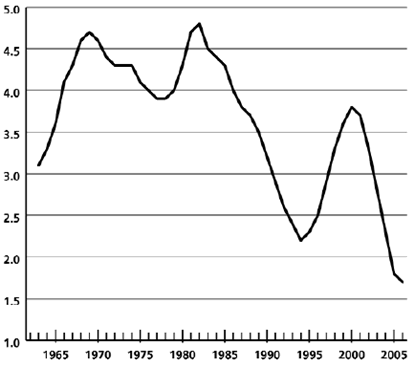
(...) It was netinvestment in the private sector that was once the major driver of the capitalist economy, absorbing a growing economic surplus. It was relatively high net private non-residential fixed investment (together with military-oriented government spending) that helped to create and sustain the “Golden Age” of the 1960s. The faltering of such investment (as a percent of GDP) in the early 1970s (with brief exceptions in the late 1970s–early 1980s, and late 1990s), signaled that the economy was unable to absorb all of the investment-seeking surplus that it was generating, and thus marked the onset of deepening stagnation in the real economy of goods and services. The whole problem has gotten worse over time. Nine out of the ten years with the lowest net non-residential fixed investment as a percent of GDP over the last half century (up through 2006) were in the 1990s and 2000s. Between 1986 and 2006, in only one year—2000, just before the stock market crash—did the percent of GDP represented by net private non-residential fixed investment reach the average for 1960–79 (4.2 percent). This failure to invest is clearly not due to a lack of investment-seeking surplus. One indicator of this is that corporations are now sitting on a mountain of cash—in excess of $600 billion in corporate savings that have built up at the same time that investment has been declining due to a lack of profitable outlets. What has mainly kept things from getting worse in the last few decades as a result of the decline of net investment and limits on civilian government spending has been soaring finance. This has provided a considerable outlet for economic surplus in what is called FIRE (finance, insurance, and real estate), employing many new people in this non-productive sector of the economy, while also indirectly stimulating demand through the impact of asset appreciation (the wealth effect).

(...) It was netinvestment in the private sector that was once the major driver of the capitalist economy, absorbing a growing economic surplus. It was relatively high net private non-residential fixed investment (together with military-oriented government spending) that helped to create and sustain the “Golden Age” of the 1960s. The faltering of such investment (as a percent of GDP) in the early 1970s (with brief exceptions in the late 1970s–early 1980s, and late 1990s), signaled that the economy was unable to absorb all of the investment-seeking surplus that it was generating, and thus marked the onset of deepening stagnation in the real economy of goods and services. The whole problem has gotten worse over time. Nine out of the ten years with the lowest net non-residential fixed investment as a percent of GDP over the last half century (up through 2006) were in the 1990s and 2000s. Between 1986 and 2006, in only one year—2000, just before the stock market crash—did the percent of GDP represented by net private non-residential fixed investment reach the average for 1960–79 (4.2 percent). This failure to invest is clearly not due to a lack of investment-seeking surplus. One indicator of this is that corporations are now sitting on a mountain of cash—in excess of $600 billion in corporate savings that have built up at the same time that investment has been declining due to a lack of profitable outlets. What has mainly kept things from getting worse in the last few decades as a result of the decline of net investment and limits on civilian government spending has been soaring finance. This has provided a considerable outlet for economic surplus in what is called FIRE (finance, insurance, and real estate), employing many new people in this non-productive sector of the economy, while also indirectly stimulating demand through the impact of asset appreciation (the wealth effect).
Friday, May 9, 2008
speculate to accumulate:
History repeats itself, one speculation after another. The Federal Reserve’s monetary policy encourages debt, first the internet bubble, now the real estate bubble. In 2006 the IMF was still saying there was “every indication the mechanisms for granting loans on the US property market were still relatively effective”. Market effective. Perhaps the two words should be welded together once and for all. The real estate bubble has burst. So the speculators are resurrecting an old eldorado: the grain markets. Purchasing contracts to deliver wheat or rice at a future date and counting on selling them at a higher price. And what ensures prices will keep on rising? Famine.
History repeats itself, one speculation after another. The Federal Reserve’s monetary policy encourages debt, first the internet bubble, now the real estate bubble. In 2006 the IMF was still saying there was “every indication the mechanisms for granting loans on the US property market were still relatively effective”. Market effective. Perhaps the two words should be welded together once and for all. The real estate bubble has burst. So the speculators are resurrecting an old eldorado: the grain markets. Purchasing contracts to deliver wheat or rice at a future date and counting on selling them at a higher price. And what ensures prices will keep on rising? Famine.
Saturday, April 19, 2008
resurrecting greenspan:
Hillary Clinton proposed that Congress show its bipartisan spirit by appointing an "emergency working group on foreclosures," to be led by none other than Alan Greenspan and earlier Federal Reserve Chairman Paul Volcker, and Clinton Treasury Secretary Robert Rubin. Her idea was for them to come up with a plan to alleviate the subprime and financial crisis. This seems like calling in arsonists to help put out the fire that they and their own constituency had set in the first place. Their lifelong interest, after all, had been to promote deregulation and special tax favoritism for their Wall Street constituency, highlighted by repeal of Glass-Steagall in 1999 under Pres. Clinton. Representing the banking sector and Wall Street (and hence being essentially Republicans in spirit), they were precisely the lobbyists most in favor of anti-labor, pro-creditor policies.
(...) ...it was Greenspan that acted as a kind of economic Karl Rove in crafting anti-labor policies favoring the very rich, above all the Social Security tax-shift onto labor's shoulders to which Mrs. Clinton pointed. He welcomed recession as an excuse to cut taxes, ostensibly to "jump-start" economic growth but actually producing a benefit mainly for wealthy investors and property owners.
(...) The Bush Administration's enormous commitment of public funds to support Wall Street prompted columnist Martin Wolf of the Financial Times to announce that the free market was dead. "Remember Friday March 14, 2008," he wrote; "it was the day the dream of global free-market capitalism died. Deregulation has reached its limits." The price for Treasury support would have to be an end to the deregulation that had permitted the debt crisis to reach such unprecedented proportions. As evidence of the new attitude Wolf cited "the remark by Joseph Ackermann, chief executive of Deutsche Bank, that 'I no longer believe in the market's self-healing power.'"
(...) Financial lobbyists accordingly anticipate that "the coming fight will rival the storm leading up to the 1999 passage of the Gramm-Leach-Bliley Act [which repealed Glass-Steagall]. That law made it easier for securities firms and banks to be owned by the same company, dropping regulatory barriers in place since the Great Depression. In 1998 and 1999, when Congress was finalizing passage of that law, the financial-services industry spent a combined $417 million on lobbying, according to the Center for Responsive Politics. In 2007, financial-services companies spent more than $402 million on lobbying, led by $138 million from the insurance industry."
(...) Repeal of Glass-Steagall gave the subprime debacle its jump start by removing the Depression-era roadblock from bank merging with brokers. This permitted financial conglomerates to be formed and gave them the ability to securitize (that is package), loans as investments. Vertical financial conglomerates were formed, starting with Citibank's merger with Travelers Insurance, and leading up to the recent intention of Bank of America to acquire the troubled Countrywide Financial, the nation's leading subprime lender.
(...) The implication is that anything that lowers costs to Wall Street--by rolling back regulatory bureaucracies and reporting requirements such as are called for by the Sarbanes-Oxley legislation--will be passed on to customers. Such presumptions ignore the fact that Wall Street prefers to pay out its profits as bonuses or dividends rather than pass on cost savings. What is passed onto its customers instead is runaway CEO compensation. "Market discipline" has not kept financial markets honest or low-priced. Deceptive subprime practices have made dollar investments a pariah in global financial markets. Investors have lost faith in the nation's investment bankers, mortgage brokers and credit-rating firms, drying up the market for U.S. mortgage-backed securities and leading to their being dumped across the board.
(...)What seems most remarkable in Mr. Paulson's and Dr. Bernanke's comments is the absence of quantitative discussion of just what the "systemic risk" is. The bailout is to be paid by the non-financial sector, above all labor ("consumers") to "save the system." But just what is the system? It certainly is not industrial production. It is more a faith that compound interest can keep on expanding ad infinitum. The reality is that the exponentially soaring debt overhead threatens to plunge the economy into chronic depression as interest and other financial charges eat further and further into the economy's ability to spend on consumption and tangible capital investment. To ignore this financial dynamic is to turn economics into a junk science.
(...) For the past decade the banking system and its mortgage-broker affiliates have avoided the usual wave of defaults and insolvencies by lending debtors enough money to pay the interest charges. Adding the interest onto the debt in this way is known as a Ponzi scheme. It requires an exponentially growing influx of funds to pay investors and creditors, and hence cannot be sustained for long, because no economy in history has grown at the exponential rates needed to keep up with the debt overhead. This is the basic problem at the core of today's economic policy. It aims to save the "sanctity of debt," that is, the financial sector's claims on the rest of the economy. But this attempt only polarizes the economy between creditors at the top of the pyramid and an increasingly indebted base at the bottom.
(...) So let's start by discarding the inane propaganda about unmanaged (that is, deregulated) "free" economies, the faith-based belief that self-regulating economic systems exist that must not be "interfered with" by government bureaucrats, formerly known as regulatory agencies, attorneys general and state prosecutors, Congressional oversight committees and what remains of New Deal agencies. This anti-government, anti-regulatory propaganda has been pushed for decades so that public agencies and Congress, supposed to act as representatives of the people, remain only passive spectators to an economy left in private hands for financial profit. The reality is that all economies are managed, either by the private sector or by government--usually by a combination of the two. Any successful economy engages in forward planning, and any well-balanced economy shapes how "the market" operates. Adam Smith's Wealth of Nations was all about how wise governments should shape--and tax--their markets. America's present-day economic system didn't evolve through natural forces, much less by divine intervention. Its industrial takeoff was subsidized by protective tariffs, internal improvements--that is, public infrastructure spending--and increasingly progressive taxation.
Hillary Clinton proposed that Congress show its bipartisan spirit by appointing an "emergency working group on foreclosures," to be led by none other than Alan Greenspan and earlier Federal Reserve Chairman Paul Volcker, and Clinton Treasury Secretary Robert Rubin. Her idea was for them to come up with a plan to alleviate the subprime and financial crisis. This seems like calling in arsonists to help put out the fire that they and their own constituency had set in the first place. Their lifelong interest, after all, had been to promote deregulation and special tax favoritism for their Wall Street constituency, highlighted by repeal of Glass-Steagall in 1999 under Pres. Clinton. Representing the banking sector and Wall Street (and hence being essentially Republicans in spirit), they were precisely the lobbyists most in favor of anti-labor, pro-creditor policies.
(...) ...it was Greenspan that acted as a kind of economic Karl Rove in crafting anti-labor policies favoring the very rich, above all the Social Security tax-shift onto labor's shoulders to which Mrs. Clinton pointed. He welcomed recession as an excuse to cut taxes, ostensibly to "jump-start" economic growth but actually producing a benefit mainly for wealthy investors and property owners.
(...) The Bush Administration's enormous commitment of public funds to support Wall Street prompted columnist Martin Wolf of the Financial Times to announce that the free market was dead. "Remember Friday March 14, 2008," he wrote; "it was the day the dream of global free-market capitalism died. Deregulation has reached its limits." The price for Treasury support would have to be an end to the deregulation that had permitted the debt crisis to reach such unprecedented proportions. As evidence of the new attitude Wolf cited "the remark by Joseph Ackermann, chief executive of Deutsche Bank, that 'I no longer believe in the market's self-healing power.'"
(...) Financial lobbyists accordingly anticipate that "the coming fight will rival the storm leading up to the 1999 passage of the Gramm-Leach-Bliley Act [which repealed Glass-Steagall]. That law made it easier for securities firms and banks to be owned by the same company, dropping regulatory barriers in place since the Great Depression. In 1998 and 1999, when Congress was finalizing passage of that law, the financial-services industry spent a combined $417 million on lobbying, according to the Center for Responsive Politics. In 2007, financial-services companies spent more than $402 million on lobbying, led by $138 million from the insurance industry."
(...) Repeal of Glass-Steagall gave the subprime debacle its jump start by removing the Depression-era roadblock from bank merging with brokers. This permitted financial conglomerates to be formed and gave them the ability to securitize (that is package), loans as investments. Vertical financial conglomerates were formed, starting with Citibank's merger with Travelers Insurance, and leading up to the recent intention of Bank of America to acquire the troubled Countrywide Financial, the nation's leading subprime lender.
(...) The implication is that anything that lowers costs to Wall Street--by rolling back regulatory bureaucracies and reporting requirements such as are called for by the Sarbanes-Oxley legislation--will be passed on to customers. Such presumptions ignore the fact that Wall Street prefers to pay out its profits as bonuses or dividends rather than pass on cost savings. What is passed onto its customers instead is runaway CEO compensation. "Market discipline" has not kept financial markets honest or low-priced. Deceptive subprime practices have made dollar investments a pariah in global financial markets. Investors have lost faith in the nation's investment bankers, mortgage brokers and credit-rating firms, drying up the market for U.S. mortgage-backed securities and leading to their being dumped across the board.
(...)What seems most remarkable in Mr. Paulson's and Dr. Bernanke's comments is the absence of quantitative discussion of just what the "systemic risk" is. The bailout is to be paid by the non-financial sector, above all labor ("consumers") to "save the system." But just what is the system? It certainly is not industrial production. It is more a faith that compound interest can keep on expanding ad infinitum. The reality is that the exponentially soaring debt overhead threatens to plunge the economy into chronic depression as interest and other financial charges eat further and further into the economy's ability to spend on consumption and tangible capital investment. To ignore this financial dynamic is to turn economics into a junk science.
(...) For the past decade the banking system and its mortgage-broker affiliates have avoided the usual wave of defaults and insolvencies by lending debtors enough money to pay the interest charges. Adding the interest onto the debt in this way is known as a Ponzi scheme. It requires an exponentially growing influx of funds to pay investors and creditors, and hence cannot be sustained for long, because no economy in history has grown at the exponential rates needed to keep up with the debt overhead. This is the basic problem at the core of today's economic policy. It aims to save the "sanctity of debt," that is, the financial sector's claims on the rest of the economy. But this attempt only polarizes the economy between creditors at the top of the pyramid and an increasingly indebted base at the bottom.
(...) So let's start by discarding the inane propaganda about unmanaged (that is, deregulated) "free" economies, the faith-based belief that self-regulating economic systems exist that must not be "interfered with" by government bureaucrats, formerly known as regulatory agencies, attorneys general and state prosecutors, Congressional oversight committees and what remains of New Deal agencies. This anti-government, anti-regulatory propaganda has been pushed for decades so that public agencies and Congress, supposed to act as representatives of the people, remain only passive spectators to an economy left in private hands for financial profit. The reality is that all economies are managed, either by the private sector or by government--usually by a combination of the two. Any successful economy engages in forward planning, and any well-balanced economy shapes how "the market" operates. Adam Smith's Wealth of Nations was all about how wise governments should shape--and tax--their markets. America's present-day economic system didn't evolve through natural forces, much less by divine intervention. Its industrial takeoff was subsidized by protective tariffs, internal improvements--that is, public infrastructure spending--and increasingly progressive taxation.
Friday, September 28, 2007
monthly review notes from the editors:
Real global growth averaged 4.9 percent a year during the Golden Age of national Keynesianism (1950–1973). It was 3.4 percent between 1974 and 1979; 3.3 percent in the 1980s; and only 2.3 percent in the 1990s, the decade with the slowest growth since World War II. The slowing of the real economy led investors to seek higher returns in financial speculation....[I]increased liquidity and lower costs of borrowing encouraged in turn further expansion of finance. The coincident trends of growing inequality and insecurity...and the spreading power of rapid financialization do not suggest a smooth continued expansion path for a society based on increased debt and growing leverage.
Real global growth averaged 4.9 percent a year during the Golden Age of national Keynesianism (1950–1973). It was 3.4 percent between 1974 and 1979; 3.3 percent in the 1980s; and only 2.3 percent in the 1990s, the decade with the slowest growth since World War II. The slowing of the real economy led investors to seek higher returns in financial speculation....[I]increased liquidity and lower costs of borrowing encouraged in turn further expansion of finance. The coincident trends of growing inequality and insecurity...and the spreading power of rapid financialization do not suggest a smooth continued expansion path for a society based on increased debt and growing leverage.
Saturday, April 21, 2007
vijay prashad on the darker nations
The book is a history of the Third World project. It is this project's development that I trace from the 1920s to the 1980s. A wide range of initiatives came together in a relatively coherent platform of demands that was pushed at various United Nations and international forums. That project was assassinated in the 1980s by a combination of the exhaustion of the way the various regimes operated in their societies, by the debt crisis (itself a product of a newly confident financial capitalism), the collapse of the Soviet Union, etc. The people who live in the societies that once adopted the Third World project of course live on, and certainly they are making history. But not on the same platform as they once were.
(...) I believe that the contours of the Third World project need to be totally rethought. For instance, the Third World project did not fully grapple with the problem posed by an energetic and "free" finance capital, whose own relations to the state changed in the 1960s and 1970s. Castro, at the 1983 NAM meeting, raised this problem, but it was generally discounted. He proposed, for instance, that there be a Third World debt servicing payments strike. This would have been a very powerful way to at least reveal the power of finance capital, and its stranglehold on sustainable development. It was not to be, as I recount.
(...) From my point of view, the basic thesis of the national liberation women's rights platform is this: that their societies are torn by sexist traditions; that their states are plagued by misogynist laws; but that their social and political histories demonstrate that women within these societies can challenge national liberation and the Third World project to extend itself in a positive direction. They rejected "humanitarian interventionism" at the same time as they called for an internationalist critique of sexist injustice. The women in these movements had no illusions that their were problems within their political parties and formations, that they needed to fight on many fronts – against allies and enemies. That is the basic point of "Cairo." The UN dynamic that led to Beijing (1995) draws from this lineage.
The book is a history of the Third World project. It is this project's development that I trace from the 1920s to the 1980s. A wide range of initiatives came together in a relatively coherent platform of demands that was pushed at various United Nations and international forums. That project was assassinated in the 1980s by a combination of the exhaustion of the way the various regimes operated in their societies, by the debt crisis (itself a product of a newly confident financial capitalism), the collapse of the Soviet Union, etc. The people who live in the societies that once adopted the Third World project of course live on, and certainly they are making history. But not on the same platform as they once were.
(...) I believe that the contours of the Third World project need to be totally rethought. For instance, the Third World project did not fully grapple with the problem posed by an energetic and "free" finance capital, whose own relations to the state changed in the 1960s and 1970s. Castro, at the 1983 NAM meeting, raised this problem, but it was generally discounted. He proposed, for instance, that there be a Third World debt servicing payments strike. This would have been a very powerful way to at least reveal the power of finance capital, and its stranglehold on sustainable development. It was not to be, as I recount.
(...) From my point of view, the basic thesis of the national liberation women's rights platform is this: that their societies are torn by sexist traditions; that their states are plagued by misogynist laws; but that their social and political histories demonstrate that women within these societies can challenge national liberation and the Third World project to extend itself in a positive direction. They rejected "humanitarian interventionism" at the same time as they called for an internationalist critique of sexist injustice. The women in these movements had no illusions that their were problems within their political parties and formations, that they needed to fight on many fronts – against allies and enemies. That is the basic point of "Cairo." The UN dynamic that led to Beijing (1995) draws from this lineage.
Sunday, April 15, 2007
william robertson on transnational capital:
The key characteristic of this new epoch is the rise of truly transnational capital and a new globally integrated production and financial system. Production has become fragmented into countless and constantly changing phases that are decentralized and dispersed across the planet. In turn, the distinct segments are functionally integrated into vast global chains of production and distribution. Each autonomous national economy has been restructured and externally integrated, so that each “national” economy because a constituent part of the larger global production system.
(...) We also now have a truly global financial system. There is no longer any such thing as a national financial system. In fact, finance capital is the most mobile and the most transnationalized fraction of capital. This has major implications. Money capital exists in cyberspace, where it recognizes no borders and faces few, if any, state controls. Money capital subordinates fixed capital. Those who control money capital can appropriate values anywhere in the world by financial manipulation and relocate them on an ongoing basis to anywhere else in the world.
(...) I am pointing this out because it is transnational capital that stands at the pinnacle of these global networks. This means that there still may be local and national capitals but they cannot compete with transnationally mobile capital. If they want to remain competitive, if they want to continue playing the game, they must link up with transnational capital, and they must do so, structurally, in a way that subordinates them to transnational capital.
(...) [can we also speak of a global working class?]
Yes. There is a global working class that runs the factories, farms, and offices of the global economy. Their ranks can be found in the maquiladoras, in the agro-industrial complexes around the world, among the armies of service workers in global cities. However, the global working class is internally stratified. It is divided along national - as well as racial, ethnic, and gender - lines. The continued existence of the nation-state serves to distort the consciousness and subjective experience of the global working class.
[a capitalist class?] In distinction, the transnational capitalist class is a class group with a subjective consciousness of itself and its interests. Its members increasingly socialize together in their private institutions such as the World Economic Forum in Davos and develop a transnational class consciousness. In this sense it is a class-for-itself, to use Marx’s language on this matter, whereas the global working class is a class-in-itself but not yet for-itself.
(...) The question is how can the transnational capitalist class exercise its political authority? Well, one way is through utilizing existing state apparatus in each country, and we have seen plenty of that. Another is through the transformation of existing international institutions, such as the old Bretton Woods institutions or the agencies of the United Nations system, and the creation of entirely new ones, such as the World Trade Organization. Transnational capital attempts to convert the structural power of the global economy over individual countries and over working classes in each nation-state into direct political authority or influence through this transnational state apparatus. Transnational institutions attempt to coordinate global capitalism and imposing capitalist domination beyond national borders. The IMF, for instance, by imposing a structural adjustment program that opens up a given country to the penetration of transnational capital, the subordination of local labor, and the extraction of wealth by transnational capitalists, is operating as a transnational state institution to facilitate the exploitation of local labor by global capital.
(...) [on the transnational character of imperialism; nation-state less important in this process?] If by imperialism, we mean relentless pressures for outward expansion of capitalism and distinct political, military and cultural mechanisms that facilitate that expansion, then, yes, we are obviously seeing ongoing imperialism in 21st century. But there is nothing in this “new” imperialism to suggest it is a U.S. drive for empire in competition with other nation-state capitalists. Those who make this argument have frozen their historical analysis in an earlier moment. They are trapped in world of late 19th and early 20th century. They see world capitalism as still in its national “monopoly” stage of Lenin’s and Hilferding’s day, so that U.S. interv ntionism can only be a drive for “U.S.” hegemony over other states.
Recent U.S. policies such as the imposition of neo-liberal structural adjustment programs and sponsorship of free trade agreements have served to further pry open regions and sectors around world to global capitalism, to transnational capital. The IMF and other transnational state agencies have not acted as simple instruments of “U.S.” imperialism. I know of no single IMF structural adjustment program that creates conditions in intervened country that favors “U.S.” capital in any special way, rather than opening up the intervened country, its labor and resources, to capitalists from any corner of world.
(...) [and the effects?] The system is in chaos; its contradictions are explosive and, frankly, humanity is in grave danger. The global crisis is one of social polarization and social reproduction, reflecting the deeper structural problem of over-accumulation. The crisis is also of sustainability. An ecological holocaust has already begun. If we do not pull back from the precipice, and very soon, we could well be facing catastrophic consequences.
(...) [and the big picture?] Let’s step back and see the big picture. The 1980s saw a recovery of profits following the decline of the 1970s. There was a massive wave of transnational investment in the 1980s and the 1990s, leading to overcapacity and overproduction. Capital began increasingly to seek an investment outlet through financial speculation – the notorious “casino capitalism.” The volatility of financial speculation in the face of over-accumulation led to the 1995 Mexico peso crisis and its “tequila effect” elsewhere, followed by the 1997-98 Asian financial meltdown, the Russian, Turkish, and Brazilian crises, and worldwide recession in 2001-02. It is at this point that structural and political pressures building up in the system lead towards a militarization of global accumulation. The U.S. state as the guarantor of the system sought to open up new outlets for the global surplus through a military Keynesianism and a war mobilization, through the “creative destruction” of war. From the 1990s to date we seen a shift in the axis of accumulation, from computer and information technology as the cutting edge, along with financial speculation in stocks, real estate, and so forth, to a military-industrial-petroleum-construction-engineering complex.
(...) [social welfare to social control] We are seeing a transition from social welfare to social control states, the rise of police states that manage prison-industrial complexes to contain the excluded population, new forms of social and spatial apartheid, social cleansing, Katrina-type militarized control responses to disasters and other stresses. We may be heading more generally towards a global police state.
(...) [Hasn’t globalization also led many nations out from underdevelopment?] Your question is phrased within a misleading nation-state framework of analysis, as if what “develops” or what is “underdeveloped” is a nation-state. This ignores class polarization, power relations, and social inequality within each nation-state. Globalization has turned many people in the South into participants – consumers - in the global marketplace – and spread the culture of global capitalism, with its individualism, consumerism, escapism and banality. But it has generated downward mobility, marginality and immiseration for many more. Inequalities worldwide have reached unprecedented proportions. The pattern is a polarization between 20 percent of the population that is advancing, on the one hand, and 80 percent that is falling behind, on the other. There are new transnational class inequalities that cannot be understood within the North-South divide. The global South is increasingly dispersed across the planet so too is the global North. India now has 200 million middle class consumers who participate in the global market, as does China, even while majorities in those countries sink into destitution. Global social polarization is cutting across national lines in new ways.
(...) [for the future] Social justice requires a measure of transnational social governance over this global production and financial system as a necessary first step in a radical redistribution of wealth and power to poor majorities. What would such a new redistributive component involve and how would it come about? Certainly it would require a reversal of neo-liberal policies at the nation-state level. But redistribution is not enough. It must be linked to the transformation of class and property relations. Local class and property relations have global implications. Webs of interdependence link the local to the global. Pockets of counter-hegemony are now emerging more clearly, for example, in the rise of an anti-neo-liberal power bloc in Latin America centered around Venezuela. Nonetheless, the challenge is how to convert a reactive global resistance into a proactive global program. The recent experiences of Venezuela, Brazil, South Africa, and Haiti, among others, make clear the limitations to reintroduction of a redistributive project at nation-state level alone. Any challenge to capitalist state power must involve a major transnational component. Struggles at nation-state level are far from futile. They remain central to the prospects for social justice and progressive social change. But any such struggles must be part of a more expansive transnational counterhegemonic project and a program to rein in on the global market and the power of global capital. An alternative to global capitalism must be a transnational project, involving transnational trade unionism, transnational social movements, transnational political organizations, and so on.
The key characteristic of this new epoch is the rise of truly transnational capital and a new globally integrated production and financial system. Production has become fragmented into countless and constantly changing phases that are decentralized and dispersed across the planet. In turn, the distinct segments are functionally integrated into vast global chains of production and distribution. Each autonomous national economy has been restructured and externally integrated, so that each “national” economy because a constituent part of the larger global production system.
(...) We also now have a truly global financial system. There is no longer any such thing as a national financial system. In fact, finance capital is the most mobile and the most transnationalized fraction of capital. This has major implications. Money capital exists in cyberspace, where it recognizes no borders and faces few, if any, state controls. Money capital subordinates fixed capital. Those who control money capital can appropriate values anywhere in the world by financial manipulation and relocate them on an ongoing basis to anywhere else in the world.
(...) I am pointing this out because it is transnational capital that stands at the pinnacle of these global networks. This means that there still may be local and national capitals but they cannot compete with transnationally mobile capital. If they want to remain competitive, if they want to continue playing the game, they must link up with transnational capital, and they must do so, structurally, in a way that subordinates them to transnational capital.
(...) [can we also speak of a global working class?]
Yes. There is a global working class that runs the factories, farms, and offices of the global economy. Their ranks can be found in the maquiladoras, in the agro-industrial complexes around the world, among the armies of service workers in global cities. However, the global working class is internally stratified. It is divided along national - as well as racial, ethnic, and gender - lines. The continued existence of the nation-state serves to distort the consciousness and subjective experience of the global working class.
[a capitalist class?] In distinction, the transnational capitalist class is a class group with a subjective consciousness of itself and its interests. Its members increasingly socialize together in their private institutions such as the World Economic Forum in Davos and develop a transnational class consciousness. In this sense it is a class-for-itself, to use Marx’s language on this matter, whereas the global working class is a class-in-itself but not yet for-itself.
(...) The question is how can the transnational capitalist class exercise its political authority? Well, one way is through utilizing existing state apparatus in each country, and we have seen plenty of that. Another is through the transformation of existing international institutions, such as the old Bretton Woods institutions or the agencies of the United Nations system, and the creation of entirely new ones, such as the World Trade Organization. Transnational capital attempts to convert the structural power of the global economy over individual countries and over working classes in each nation-state into direct political authority or influence through this transnational state apparatus. Transnational institutions attempt to coordinate global capitalism and imposing capitalist domination beyond national borders. The IMF, for instance, by imposing a structural adjustment program that opens up a given country to the penetration of transnational capital, the subordination of local labor, and the extraction of wealth by transnational capitalists, is operating as a transnational state institution to facilitate the exploitation of local labor by global capital.
(...) [on the transnational character of imperialism; nation-state less important in this process?] If by imperialism, we mean relentless pressures for outward expansion of capitalism and distinct political, military and cultural mechanisms that facilitate that expansion, then, yes, we are obviously seeing ongoing imperialism in 21st century. But there is nothing in this “new” imperialism to suggest it is a U.S. drive for empire in competition with other nation-state capitalists. Those who make this argument have frozen their historical analysis in an earlier moment. They are trapped in world of late 19th and early 20th century. They see world capitalism as still in its national “monopoly” stage of Lenin’s and Hilferding’s day, so that U.S. interv ntionism can only be a drive for “U.S.” hegemony over other states.
Recent U.S. policies such as the imposition of neo-liberal structural adjustment programs and sponsorship of free trade agreements have served to further pry open regions and sectors around world to global capitalism, to transnational capital. The IMF and other transnational state agencies have not acted as simple instruments of “U.S.” imperialism. I know of no single IMF structural adjustment program that creates conditions in intervened country that favors “U.S.” capital in any special way, rather than opening up the intervened country, its labor and resources, to capitalists from any corner of world.
(...) [and the effects?] The system is in chaos; its contradictions are explosive and, frankly, humanity is in grave danger. The global crisis is one of social polarization and social reproduction, reflecting the deeper structural problem of over-accumulation. The crisis is also of sustainability. An ecological holocaust has already begun. If we do not pull back from the precipice, and very soon, we could well be facing catastrophic consequences.
(...) [and the big picture?] Let’s step back and see the big picture. The 1980s saw a recovery of profits following the decline of the 1970s. There was a massive wave of transnational investment in the 1980s and the 1990s, leading to overcapacity and overproduction. Capital began increasingly to seek an investment outlet through financial speculation – the notorious “casino capitalism.” The volatility of financial speculation in the face of over-accumulation led to the 1995 Mexico peso crisis and its “tequila effect” elsewhere, followed by the 1997-98 Asian financial meltdown, the Russian, Turkish, and Brazilian crises, and worldwide recession in 2001-02. It is at this point that structural and political pressures building up in the system lead towards a militarization of global accumulation. The U.S. state as the guarantor of the system sought to open up new outlets for the global surplus through a military Keynesianism and a war mobilization, through the “creative destruction” of war. From the 1990s to date we seen a shift in the axis of accumulation, from computer and information technology as the cutting edge, along with financial speculation in stocks, real estate, and so forth, to a military-industrial-petroleum-construction-engineering complex.
(...) [social welfare to social control] We are seeing a transition from social welfare to social control states, the rise of police states that manage prison-industrial complexes to contain the excluded population, new forms of social and spatial apartheid, social cleansing, Katrina-type militarized control responses to disasters and other stresses. We may be heading more generally towards a global police state.
(...) [Hasn’t globalization also led many nations out from underdevelopment?] Your question is phrased within a misleading nation-state framework of analysis, as if what “develops” or what is “underdeveloped” is a nation-state. This ignores class polarization, power relations, and social inequality within each nation-state. Globalization has turned many people in the South into participants – consumers - in the global marketplace – and spread the culture of global capitalism, with its individualism, consumerism, escapism and banality. But it has generated downward mobility, marginality and immiseration for many more. Inequalities worldwide have reached unprecedented proportions. The pattern is a polarization between 20 percent of the population that is advancing, on the one hand, and 80 percent that is falling behind, on the other. There are new transnational class inequalities that cannot be understood within the North-South divide. The global South is increasingly dispersed across the planet so too is the global North. India now has 200 million middle class consumers who participate in the global market, as does China, even while majorities in those countries sink into destitution. Global social polarization is cutting across national lines in new ways.
(...) [for the future] Social justice requires a measure of transnational social governance over this global production and financial system as a necessary first step in a radical redistribution of wealth and power to poor majorities. What would such a new redistributive component involve and how would it come about? Certainly it would require a reversal of neo-liberal policies at the nation-state level. But redistribution is not enough. It must be linked to the transformation of class and property relations. Local class and property relations have global implications. Webs of interdependence link the local to the global. Pockets of counter-hegemony are now emerging more clearly, for example, in the rise of an anti-neo-liberal power bloc in Latin America centered around Venezuela. Nonetheless, the challenge is how to convert a reactive global resistance into a proactive global program. The recent experiences of Venezuela, Brazil, South Africa, and Haiti, among others, make clear the limitations to reintroduction of a redistributive project at nation-state level alone. Any challenge to capitalist state power must involve a major transnational component. Struggles at nation-state level are far from futile. They remain central to the prospects for social justice and progressive social change. But any such struggles must be part of a more expansive transnational counterhegemonic project and a program to rein in on the global market and the power of global capital. An alternative to global capitalism must be a transnational project, involving transnational trade unionism, transnational social movements, transnational political organizations, and so on.
Subscribe to:
Posts (Atom)